
Homeowners · Winter · NH, MA & CT
By Jon Merwin, Founder and CEO
Updated October 2026
- No one company handles snow and ice damage best for every home. What matters is the policy you buy: the form, the endorsements, the deductibles and how your roof is settled.
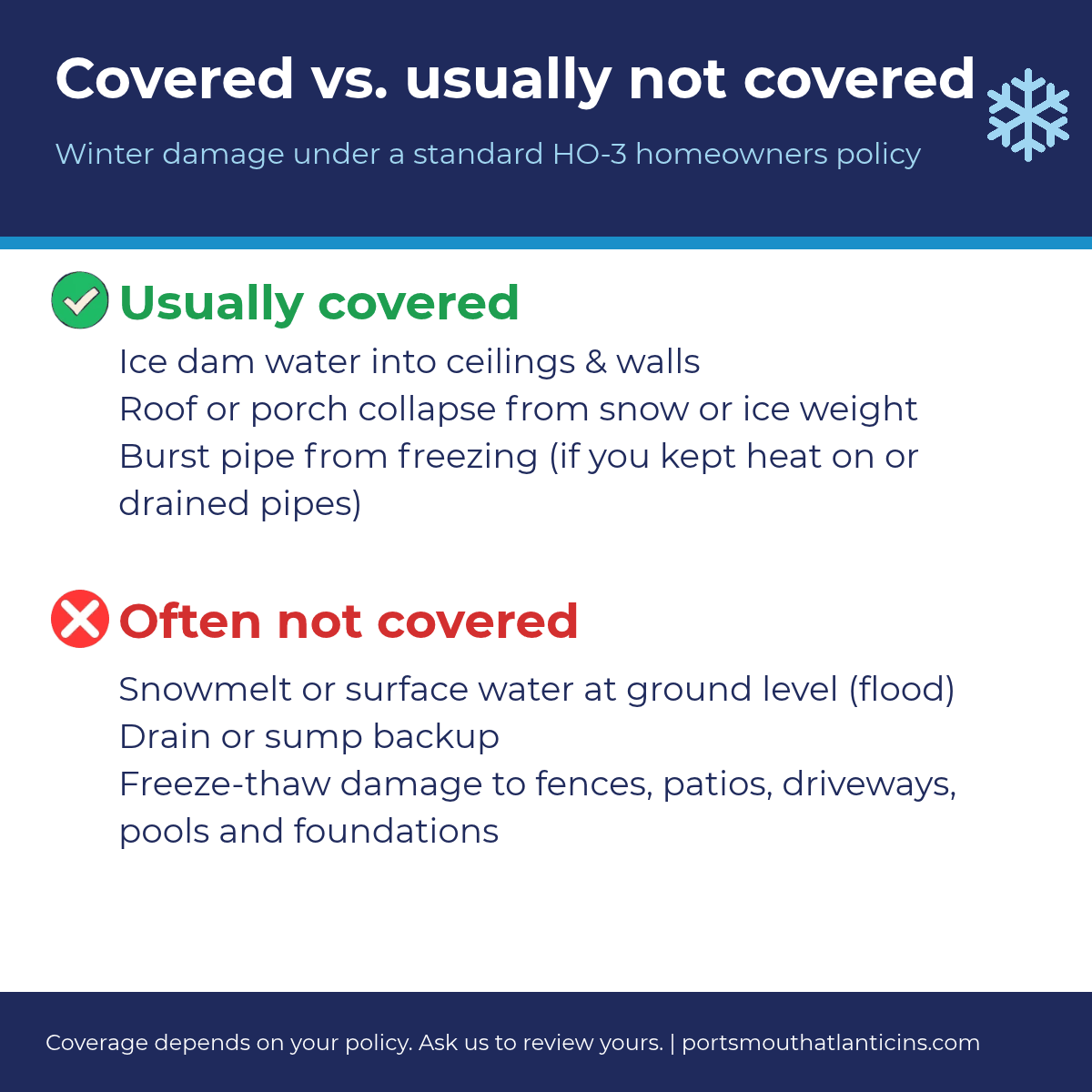
- Most standard homeowners policies (the HO-3) cover water damage from ice dams, roof collapse from the weight of snow or ice, and burst pipes, as long as you kept the heat on or drained the system.
- Flood, sewer or drain backup, ice dam removal and wear-and-tear are commonly excluded or limited. Check those lines before winter, not after.
- Your liability coverage generally applies if a guest slips on your icy walk and you’re found responsible. Medical payments coverage can pay a guest’s medical bills regardless of fault.
- An independent agent can put the same home in front of several carriers and compare these details side by side.
Every winter, homeowners in New Hampshire, Massachusetts and Connecticut ask us some version of the same question: which insurance company is best for snow and ice damage? The honest answer is that the company matters less than the policy. Two homeowners with the same carrier can have very different winter protection depending on the form they bought, the endorsements they added and how their roof is valued. This guide walks through what a standard policy covers, where the gaps usually are, and how we compare carriers for a Northeast home.
Which insurance companies handle snow and ice damage best?
For most homes, the “best” carrier is the one whose policy fits your house and closes the gaps that winter tends to expose. Many insurers build their homeowners policies on standard forms like the ISO HO-3, so the core winter coverages often look similar from one company to the next. The real differences tend to show up in:
- Endorsements. Whether water backup or sump overflow coverage is available, and at what limit.
- Deductibles. Some policies carry a separate or higher deductible for certain water or weather losses.
- Roof settlement. Some policies pay replacement cost on a roof, while others pay actual cash value (depreciated) on older roofs. After a heavy snow year, that difference is real money.
- Underwriting. Roof age, heating system, plumbing and whether the home sits empty part of the year all affect which carriers will write it and on what terms.
If you want to see how a company treats its customers, the NAIC’s Consumer Insurance Search lets you look up closed, confirmed complaints against an insurer, along with its licensing and financial information. The NAIC itself cautions against judging a company on any one number, so treat it as one input.
What does a standard HO-3 cover in winter, and what doesn’t it?
The table below follows the ISO HO-3 sample form published by the Insurance Information Institute and guidance from the Massachusetts, New Hampshire and Connecticut insurance departments. Your own policy and endorsements control, so use this as a checklist, not a promise.
| Winter situation | Standard HO-3, generally | What to check |
|---|---|---|
| Water leaking into ceilings and walls from an ice dam | Usually covered | Many policies don’t pay to remove the ice dam itself |
| Roof or porch collapse from the weight of snow or ice | Usually covered | Damage from age or pre-existing problems can be denied; sagging or cracking alone isn’t “collapse” under the form |
| Burst pipe from freezing | Covered if you used reasonable care to keep heat on, or shut off and drained the water | Vacant homes, second homes and homes without heat get the most scrutiny |
| Tree knocked onto the house by ice or snow | Usually covered | Removing a fallen tree that doesn’t hit a structure is generally not covered |
| Snowmelt or surface water coming in at ground level | Not covered (flood exclusion) | Flood insurance is a separate policy |
| Water backing up through a drain or out of a sump | Not covered | Water backup endorsement, and its limit |
| Freeze-thaw damage to a fence, patio, driveway, pool or foundation | Excluded under the form | Ask whether your policy changes this |
| Slow leaks, rot or damage from poor maintenance | Not covered | Fix small leaks before winter |
| Food spoiled during a power outage | Often not covered | Varies by policy; some add limited coverage |
| A guest slips on your icy walkway | Liability and medical payments coverage generally apply | Your liability limit; consider an umbrella |
| You hurt yourself shoveling | Not covered by homeowners | That’s health insurance territory |
Are ice dams covered by homeowners insurance?
Usually, yes, for the damage they cause. An ice dam forms when snow on a warm roof melts, runs down to the colder eaves and refreezes. Water then backs up under the shingles and into the house. The Connecticut Insurance Department says interior or exterior damage caused by an ice dam is generally covered, but many policies don’t pay to remove the ice dam. If you’re paying someone to steam the dam off your roof, assume that bill is yours unless your policy says otherwise.
Ice dams that come back every winter are a warning sign for underwriters and adjusters. Better attic insulation and ventilation, clean gutters and heat cables along the eaves are the fixes state regulators point to.
Does insurance cover a roof collapse from heavy snow?
Generally, yes. The Massachusetts Division of Insurance lists collapse of a structure due to the weight of ice or snow among the losses covered under most standard homeowners policies, and the HO-3 covers collapse caused by its named perils, which include weight of ice, snow or sleet. Two cautions. First, the form defines collapse as an abrupt falling down, so a roof that’s sagging or cracked but still standing isn’t “collapsed” in policy terms. Second, the Connecticut Insurance Department notes that damage tied to age or pre-existing problems can be denied. Keeping the roof in good shape and clearing heavy loads safely, ideally with a professional, protects both the house and the claim.
Are frozen and burst pipes covered?
Covered, with a condition. The HO-3 covers freezing of plumbing and heating systems only if you used reasonable care to maintain heat in the building, or to shut off the water and drain the systems. The New Hampshire Insurance Department’s December 2024 advisory makes the same point: coverage for a sudden burst pipe often depends on reasonable precautions, and failing to take them can lead to a denied claim. The NAIC and the Massachusetts Division of Insurance say the same thing in plain terms. If the loss comes from neglect, such as letting the house go cold when you could have kept it heated, it may not be paid.
This matters most for second homes, lake houses and any home that sits empty for a stretch in January. Tell your agent if a home will be unoccupied. Ask whether the carrier requires a minimum temperature, a water shutoff, or monitoring such as a low-temperature or water-leak sensor, and get the answer in writing.
What water damage is excluded or limited?
This is where winter claims most often go sideways. The HO-3 water damage exclusion covers three big categories:
- Flood and surface water. That includes snowmelt that pools and comes in through a basement wall or door. You need a separate flood insurance policy for that.
- Water that backs up through sewers or drains, or overflows from a sump or sump pump. Many carriers sell a water backup endorsement, usually with its own limit. Check the limit against what a finished basement would cost to redo.
- Groundwater seeping or pushing through foundations, floors and walls.
The Massachusetts Division of Insurance also notes that interior water damage from a storm is generally not covered when the roof or walls weren’t damaged first. And the form excludes freeze-thaw damage to fences, patios, pavement, pools and foundations. None of this is unusual. It’s the standard form, which is why reading your declarations page before winter is worth twenty minutes.
Am I liable if someone slips on ice at my house?
You can be, and that’s what the liability part of your homeowners policy is for. The Insurance Information Institute explains that if a fall on your property is the result of your negligence, the policy pays for damages and for the cost of defending you. Medical payments to others, Coverage F on the HO-3, can pay a guest’s medical bills without a liability claim. It doesn’t cover you or the people who live with you.
Two practical points. Check your liability limit. The III calls $100,000 the standard amount and suggests higher limits if you need more. If you have a home, cars and savings to protect, an umbrella policy adds a layer on top. And if you hire someone to plow or shovel, the Connecticut Insurance Department notes they should be covered under their own insurance, so ask for proof.
What should NH, MA and CT homeowners know about their state?
- New Hampshire. The New Hampshire Insurance Department’s frozen-pipe advisory recommends winterizing irrigation systems, detaching hoses, sealing gaps, insulating pipes in unheated spaces and letting faucets drip in extreme cold. NHID consumer services: 1-800-852-3416.
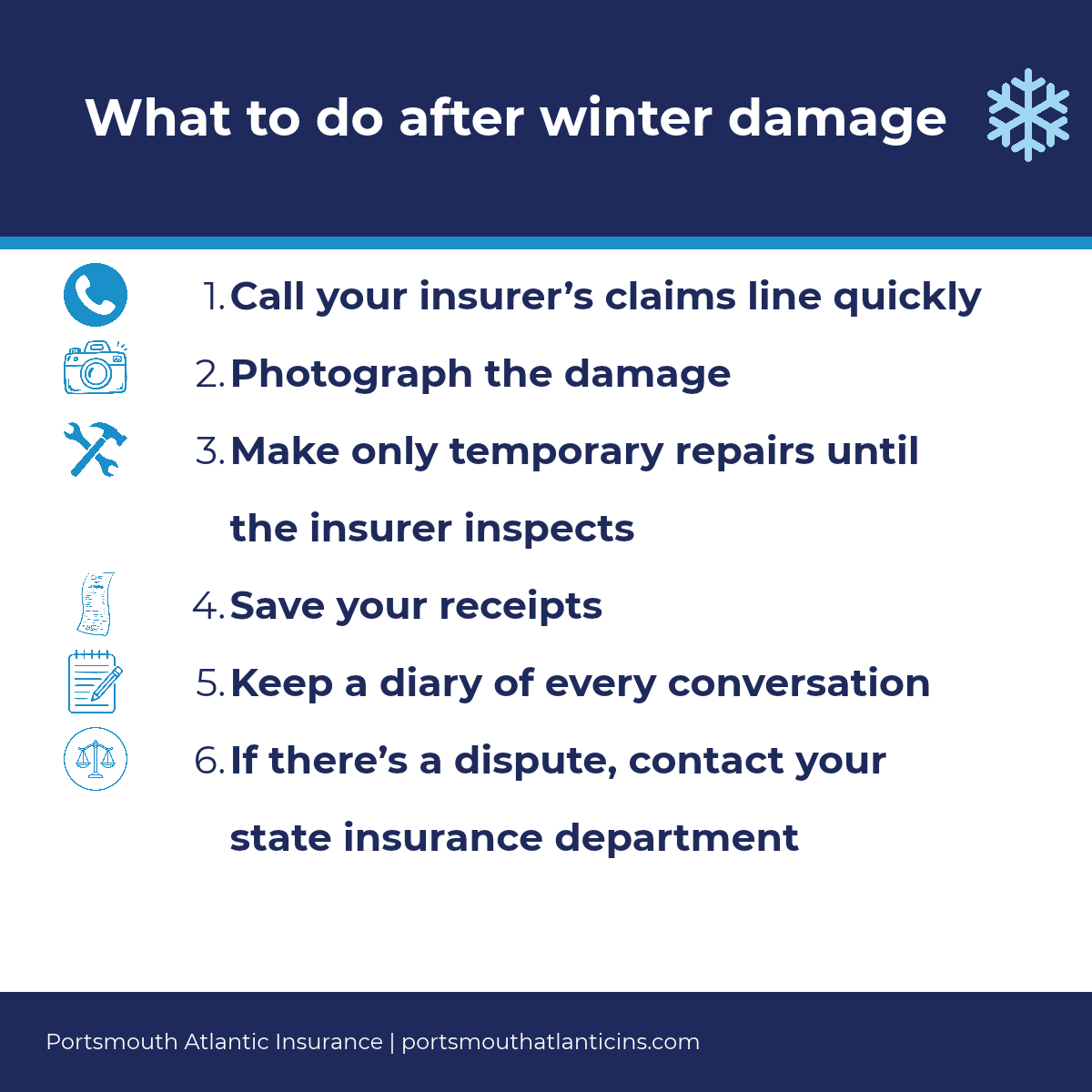
- Massachusetts. The Division of Insurance’s winter guidance lists what most standard policies cover and don’t. It also advises making only temporary repairs until the insurer has inspected and you’ve agreed on the cost.
- Connecticut. The Connecticut Insurance Department advises calling your insurer’s claims line quickly, photographing the damage, saving receipts and keeping a diary of every conversation. CID consumer line: 800-203-3447.
If you have a dispute with your insurer over a winter claim, your state insurance department can help.
How does an independent agent compare carriers for winter risk?
A captive agent can show you one company’s policy. An independent agency can quote the same home with several carriers and line up the details that matter in a Northeast winter. When we compare, we look at:
- Policy form: HO-3 or a broader form, and how each carrier words its water and collapse coverage.
- Water backup and sump overflow: whether it’s offered and at what limits.
- Deductibles: the all-perils deductible and any separate water or weather deductible.
- Roof settlement: replacement cost or actual cash value, and whether roof age changes that.
- Occupancy rules for second homes and homes that sit empty in winter.
- Liability limits, and whether an umbrella makes sense.
- Dwelling limit: whether it reflects what it would cost to rebuild today.
Depending on the home and the state, the homeowners carriers we may quote include regional mutuals such as Vermont Mutual, Andover, Safety, Concord Group and Providence Mutual, along with Openly and Plymouth Rock. For high-value homes we look at Chubb, and for homes over $3 million, Cincinnati. Which one fits depends on your house, not on a ranking. You can see the full list on our carriers page, and our no-obligation policy review is the easiest way to see how your current coverage stacks up.
If you’re still choosing an agency, our guide on how to choose an independent insurance agency in New Hampshire covers what to ask. If you’re insuring cars too, see our New Hampshire home and auto bundle guide.
- Pull your declarations page and find your deductible, dwelling limit and liability limit.
- Check whether you have water backup coverage, and its limit.
- Ask how your roof would be settled: replacement cost or actual cash value.
- Clean gutters and check attic insulation and ventilation.
- Disconnect hoses, shut off outside spigots and insulate pipes in unheated spaces.
- If a home will sit empty, keep the heat on or have the water shut off and the system drained, and tell your agent.
- Line up a snow contractor who carries their own insurance.
Frequently asked questions
Does homeowners insurance pay to remove an ice dam?
Often not. The Connecticut Insurance Department says ice dam damage to the inside or outside of the home is generally covered, but many policies don’t pay for removing the ice dam itself.
Will my claim be denied if my pipes froze while I was away?
It can be. Standard policies cover frozen pipes only if you used reasonable care to keep the heat on or to shut off and drain the water. If the home was left without heat, the claim may be denied.
Is snowmelt flooding in my basement covered?
Not under a standard homeowners policy. Surface water and flood are excluded, and water backing up through a drain or sump needs a water backup endorsement. Flood coverage is a separate policy.
Which insurance company is best for snow and ice damage in New England?
There’s no single answer. Winter coverage depends on the policy form, endorsements, deductibles and roof settlement terms, which vary by carrier and by home. An independent agent can compare several carriers for the same house so you can see the differences.
We’ll review your home coverage and compare 40+ carriers for homes in New Hampshire, Massachusetts and Connecticut.
Talk to our team: (603) 431-4020 · Get a quote
Sources
- Insurance Information Institute, Homeowners 3 Special Form (HO 00 03) sample policy
- Insurance Information Institute, Am I Covered?
- Insurance Information Institute, Winter storm alert: how to recover and rebuild with insurance
- NAIC, Will my homeowners insurance policy cover water damage from a burst pipe?
- NAIC, Consumer Insurance Search
- New Hampshire Insurance Department, Consumer guidance on preventing frozen pipes and understanding related insurance coverage (Dec. 30, 2024)
- Massachusetts Division of Insurance, Winter weather and insurance
- Connecticut Insurance Department, Winter insurance claim tips and Be Weather Ready: Winter
This page is general information, not a policy. Coverage, forms and availability vary by state, carrier and property, and every policy is subject to underwriting. Your policy documents control.

Portsmouth Atlantic Insurance is a family-owned independent agency founded in 2005, licensed in 10 states, working with 40+ carriers, 1,000+ Google reviews and over 2,000 testimonials. Meet our team.