
Home · Flood · Historic · High-Value · Massachusetts
By Jon Merwin, Founder and CEO
Published October 2026 · Updated October 8, 2026
- Portsmouth Atlantic Insurance is licensed in Massachusetts and insures Gloucester homes, condos, cars and boats from our Portsmouth, NH office.
- Gloucester’s housing is old: Census data put about 48 percent of its housing units in buildings built in 1939 or earlier, compared with about 31 percent statewide. Rebuild cost and code upgrades matter here.
- FEMA’s flood maps for Gloucester were partly revised effective July 8, 2025, and the city’s floodplain zoning now uses the July 8, 2025 Essex County map. Homeowners policies exclude flood.
- Coastal Massachusetts policies often carry a separate wind or named storm deductible, which the Division of Insurance says generally runs from 1% to 5% of insured value.
- Gloucester has a local historic district downtown and, since May 2026, a demolition delay ordinance for buildings from 1899 or earlier. Short-term rentals need a city permit, and state law requires at least $1 million in liability coverage for each one.
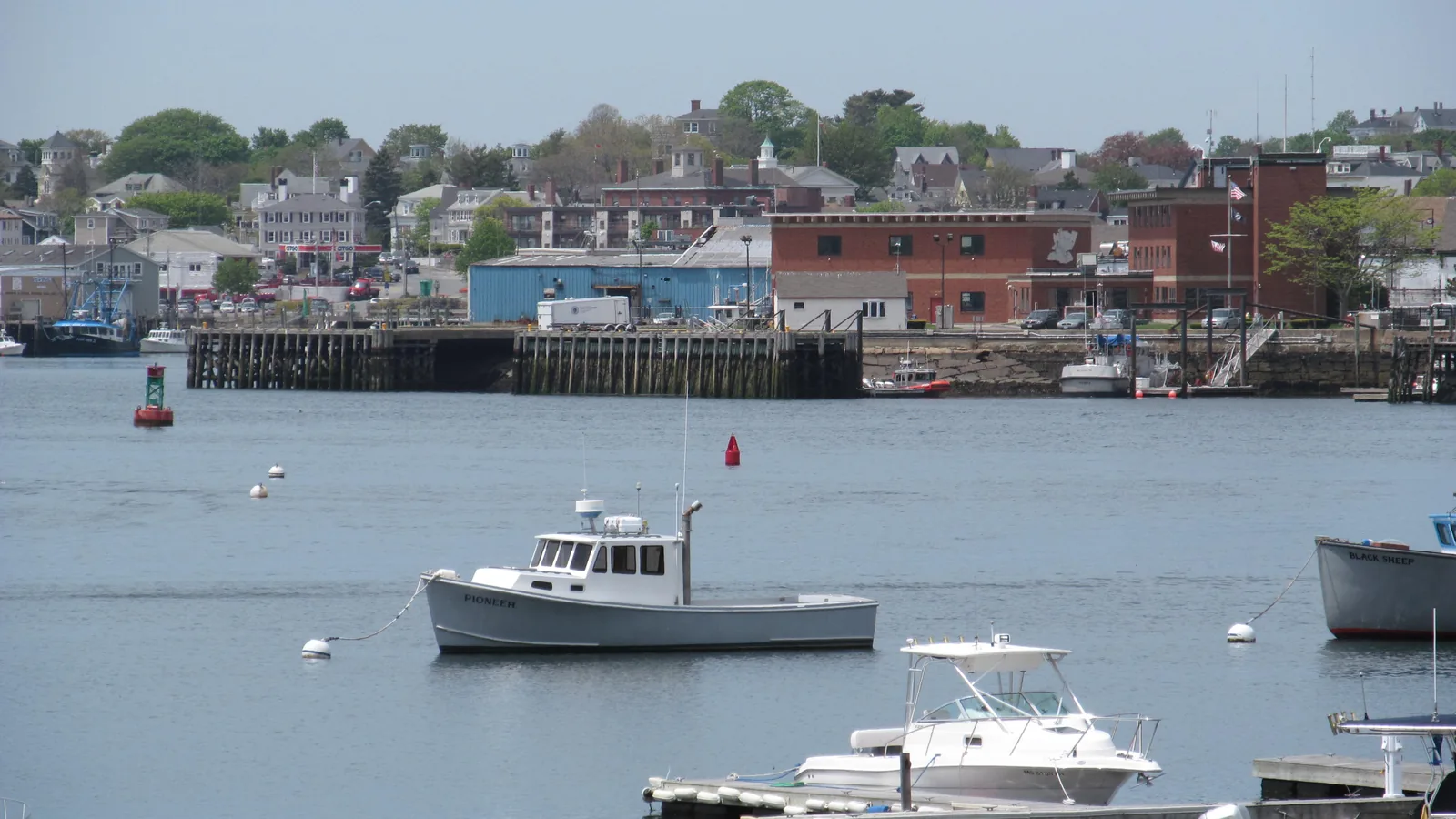
Looking for home insurance in Gloucester, Massachusetts? Portsmouth Atlantic Insurance is licensed in Massachusetts and writes a lot of Massachusetts business from our office in Portsmouth, NH. On Cape Ann we insure older homes on the hills above the harbor, houses in Rocky Neck and East Gloucester, summer places near the water in Annisquam, owner-occupied two- and three-family homes, condos and larger waterfront homes. As an independent agency, we compare 40+ carriers instead of selling one company’s policy. In Gloucester that matters, because the right carrier depends on the age of the house, how close it is to the water and whether part of it is rented.
Can a Portsmouth agency insure a home in Gloucester, Massachusetts?
Yes. We hold a Massachusetts license and work with clients by phone, email and video. Many Cape Ann owners also have a home in New Hampshire, Maine or elsewhere in Massachusetts. One agent for the homes, the cars, the boat and the umbrella keeps the coverage lined up. Along the North Shore we also insure homes in Marblehead, Manchester-by-the-Sea and Newburyport. For statewide notes, see our Massachusetts homeowners insurance page.
What does Gloucester’s housing look like?
Gloucester had 14,630 housing units in the Census Bureau’s 2019-2023 American Community Survey. About 90.1 percent were occupied as someone’s usual home, and owners occupied about 63.3 percent of those, close to the statewide 62.6 percent. About 7.6 percent of all units were held for seasonal, recreational or occasional use, about double the statewide 3.8 percent. About 51.0 percent of units are single-family detached houses (about 51.4 percent statewide), and about 32.0 percent are in buildings with two to four units, compared with about 20.0 percent statewide.
Source: U.S. Census Bureau, American Community Survey 2019-2023 5-year estimates, table B25034 (year structure built), from the ACS summary file. Our calculation. Estimates carry margins of error. Very small bars are drawn at a minimum width so the label stays readable.
Age is what stands out. About 48.5 percent of Gloucester’s units were built in 1939 or earlier, against about 30.7 percent statewide, and about 58.9 percent were built before 1960 (about 47.0 percent statewide). Older homes can be harder to rebuild to match, may have older wiring, plumbing or heating, and often need code upgrades after a loss. If you own an older house, also check whether it falls under the local historic district or the city’s demolition delay rule, covered below. If yours is a second home, see our pages on second and seasonal home insurance and Massachusetts second-home and vacation home insurance.
| Housing measure | Gloucester | Massachusetts |
|---|---|---|
| Built 1939 or earlier | 48.5% | 30.7% |
| Built before 1960 | 58.9% | 47.0% |
| Units in buildings with 2 to 4 units | 32.0% | 20.0% |
| Single-family detached houses | 51.0% | 51.4% |
| Occupied homes that are owner-occupied | 63.3% | 62.6% |
| Units held for seasonal, recreational or occasional use | 7.6% | 3.8% |
How do you insure an owner-occupied two- or three-family in Gloucester?
With about a third of the city’s housing in two- to four-unit buildings, this comes up often. If you live in one unit and rent the others, the policy has to cover the whole building, your own belongings, lost rent if tenants have to move out after a covered loss and your liability as a landlord. Many carriers, and the FAIR Plan, write owner-occupied buildings of up to four units on a homeowners form. If you move out and rent every unit, you generally need a landlord or dwelling policy instead. Our landlord insurance page and our post on landlord insurance vs. homeowners insurance explain the difference.
| Risk in Gloucester | Usually covered by homeowners | Usually not covered | What to ask |
|---|---|---|---|
| Wind damage to a roof or windows in a hurricane or nor’easter | Yes | The part under your wind or named storm deductible | Is the wind deductible a percentage, and per event or per season? |
| Storm surge or coastal flooding into the house | No | Yes | Flood zone (AE, VE or other) and an NFIP or private flood policy |
| Water backing up through a basement drain or sump | Only with a water backup endorsement | Groundwater seepage and flood | Water backup endorsement and its limit |
| Rebuilding in the local historic district or after a demolition delay | Yes, up to your limits | Extra time and cost beyond your limits | Ordinance or law limit and how long additional living expense lasts |
| A rental guest injured on the property | Depends on the rental endorsement | Short-term rental claims if excluded | Rental endorsement or separate policy; the $1 million state minimum |
| Your car flooded in a coastal storm | No (homeowners or flood) | Yes, without comprehensive | Comprehensive coverage on the auto policy |
Does homeowners insurance cover flooding in Gloucester?
No. The Massachusetts Division of Insurance (DOI) reminds homeowners that flood damage isn’t included in a standard home insurance policy. You can buy flood coverage from the National Flood Insurance Program (NFIP) or from a private insurer.
Gloucester is on FEMA’s Essex County Flood Insurance Rate Map, and part of that map changed recently. When we checked FEMA’s National Flood Hazard Layer in October 2026, roughly half of the city’s area fell on map panels revised effective July 8, 2025, and the rest on panels still dated July 16, 2014. The city’s zoning ordinance (Section 5.5) defines its Federal Floodplain District by the Essex County map and Flood Insurance Study dated July 8, 2025. The maps show Zone AE and coastal high-hazard Zone VE, where FEMA expects wave action on top of the flood, plus some Zone A areas and a Limit of Moderate Wave Action line along parts of the shore. If you haven’t looked since 2025, check your address on FEMA’s Flood Map Service Center.
Gloucester also maps a second layer. The same ordinance creates a Future Flood Risk District based on the state’s Massachusetts Coast Flood Risk Model map for 2.4 feet of sea level rise. The city says that map is for planning, and state flood-resistant construction codes apply only in the FEMA-mapped district. If you build or substantially improve in the FEMA flood zone, the city’s floodplain development permit application calls for an Elevation Certificate for all structures. It also helps when you shop for flood insurance.
- Lender requirements. FloodSmart says flood insurance is required if you own a home in a Special Flood Hazard Area and have a government-backed mortgage.
- Waiting period. FloodSmart says NFIP coverage generally takes effect 30 days after purchase, with exceptions such as a policy bought with a new or changed mortgage.
- Program status. As of early October 2026, the Congressional Research Service reports that the NFIP is authorized through December 11, 2026. Our post on the December 11 flood insurance deadline explains what to do now.
- NFIP policies. We place NFIP flood policies through Selective, an NFIP Write Your Own carrier. NFIP building coverage has a federal cap, and FloodSmart says NFIP policies don’t cover temporary housing during repairs.
- Private flood. For larger or waterfront homes we also compare private flood carriers: Flow Flood, Neptune Flood, Beyond Floods, The Flood Insurance Agency, CatCoverage and Aon Edge. Which ones can write a particular Gloucester home depends on the property.
Water from below is separate. Standard homeowners policies generally don’t cover flood or groundwater seeping in. A water backup endorsement can cover water that backs up through drains or overflows a sump. Our flood insurance page explains the flood options in more detail.
We’ll compare carriers for older, multi-family and waterfront homes and line up flood, auto, boat and umbrella coverage.
Talk to our Portsmouth team: (603) 431-4020 · Start a Gloucester home insurance quote
How do wind and named storm deductibles work in Gloucester?
The DOI says some Massachusetts policies have a separate deductible that applies only when a named storm or wind causes damage. It is usually a percentage of the home’s insured value, generally from 1% to 5%, and may apply per event, per season or per calendar year.
The FAIR Plan’s published rules treat homes near the water differently. Outside Barnstable, Dukes and Nantucket counties, its minimum named storm deductible for a home within half a mile of the coast is 1% of the dwelling limit, rising to 2% at higher limits. Farther inland, the minimum is a flat deductible amount rather than a percentage. Private carriers file their own rules, so ask us to translate any percentage into a dollar figure for your home before you choose.
What if no insurer will write a Gloucester home?
With 40+ carriers, one decline doesn’t end the search. If no company in the regular market will write the home, the DOI says the market of last resort is the Massachusetts Property Insurance Underwriting Association (MPIUA), known as the FAIR Plan, which offers basic property coverage and doesn’t cover flood. The DOI also says that as of 2025, a new FAIR Plan policy for a property in a Special Flood Hazard Area in a community overseen by the Office of Coastal Zone Management requires a separate flood policy. CZM lists Gloucester among the communities its North Shore regional office serves, and that office sits on Gloucester’s State Fish Pier.
Does Gloucester’s historic district or demolition delay affect your home insurance?
It can affect the rebuild. Central Gloucester, designated in 1977, is the city’s only local historic district, and the Historical Commission’s listings summary counts 84 historic resources in it. The Historic District Commission reviews changes to exterior architectural features visible from a public way. Under Massachusetts General Laws Chapter 40C, Section 6, no building permit for an exterior alteration and no demolition permit in a local historic district can be issued until the commission issues its certificate. See the city’s historic district map to check your address. Rocky Neck and East Gloucester Square are National Register districts; the Commission notes that a listing alone doesn’t limit a private owner unless state or federal funding, licensing or permitting is involved.
Outside the district, a newer rule applies citywide. On May 26, 2026, the City Council voted 8-1 to add a demolition delay ordinance (Chapter 5, Article VI). According to the city, it covers buildings built in or before 1899 in the state’s MACRIS inventory, which the Historical Commission’s February 2026 memo to the city estimated at about 1,100 houses. The Commission has 30 days to decide whether a building is significant. If it is, the City Council holds a public hearing, and a building found preferably preserved faces a nine-month delay on demolition while alternatives are considered.
For insurance, that points to three things: insure the house for a rebuild with the materials and details reviewers are likely to expect, ask how much the policy pays under ordinance or law coverage for code upgrades, and check how long additional living expense coverage lasts, because reviews and delays add time. Our guide to historic home insurance goes deeper.
How much dwelling coverage does a Gloucester home need?
Enough to rebuild it. The DOI notes that labor and construction costs have risen, so you may need to raise your dwelling coverage (Coverage A) to rebuild at today’s prices, and additions or remodeling can raise the rebuild cost too. For an older Gloucester house, the estimate should account for original details, today’s code and, near the water, flood-zone construction rules. We compare extended or guaranteed replacement cost options and set the limit with you.

“Inflation over the past few years has moved the goalposts on what it costs to rebuild, and that hits hard in a city with as many older homes as Gloucester. We’re seeing much higher dwelling coverage than in the past. Insurance companies are adjusting too, and expanding their appetite for higher-value homes, so Cape Ann owners have more options than they used to.”— Jon Merwin, Founder and CEO, Portsmouth Atlantic Insurance
For higher-value and waterfront homes, we compare our six high-value home carriers: Chubb, Cincinnati, Hanover, Openly, National General and Andover. For the very largest homes, we look to Chubb and Cincinnati. We also schedule jewelry, art and collections at agreed values. Our coastal Massachusetts high-value home insurance page and our high net worth insurance page go deeper.
Can you rent a Gloucester home short term?
Yes, with a city permit. Gloucester’s short-term rental ordinance (Code of Ordinances Chapter 5, Article V, starting at Section 5-63) took effect April 1, 2025, and the city takes short-term rental permit applications through its online permitting system. The city’s guidelines call for a 24-hour contact and working smoke and carbon monoxide detectors, among other safety rules. Separately, the Board of Health’s rental registration regulations, adopted April 10, 2025, require owners to register each rental unit with the Health Department, renew every year and register within 30 days of buying a rental property.
The ordinance also limits rentals of homes that aren’t the operator’s primary residence. According to the City Council’s record of its April 8, 2025 meeting, an operator may register only one such non-primary unit, and those rentals can’t exceed 120 days a year in total when the operator isn’t staying there, with an exception for units that already held a valid state short-term rental registration on April 1, 2025. Check the current ordinance before you list.
State law applies everywhere. Under Massachusetts General Laws Chapter 175, Section 4F, a short-term rental operator must carry at least $1 million in liability coverage for each short-term rental, unless the rental is offered through a hosting platform that maintains equal or greater coverage. The operator must also notify the homeowners or renters insurer, and insurers may exclude short-term rental claims from a regular homeowners policy. If the home is on the FAIR Plan, its rules allow occasional rental of up to 12 weeks a year for a year-round home and up to 4 weeks for a seasonal property. Tell us before you rent so the coverage fits.
What about condos, boats, auto and umbrella?
For a Gloucester condo, a unit-owner (HO-6) policy works alongside the association’s master policy. We read the master policy and its deductible, including any wind deductible, before quoting, and add loss assessment coverage. Every carrier we write with insures condos except Progressive and Openly. Our guides to condo insurance vs. homeowners insurance and HOA master policies explain the difference. If you own a Massachusetts condo, our guide to condex insurance in Massachusetts explains how the HO-6 and the master policy fit together. Nearby, see Rockport, MA home insurance and Ipswich, MA home insurance. Also nearby: our Essex page.
For boats, the Harbormaster’s Office says demand for moorings around Gloucester is high. It keeps a separate mooring wait list for each location, assigns an open mooring to the applicant with a suitable boat who has waited longest, and sends renewal notices each October. Under the city’s waterways regulations, a personal mooring permit can’t be transferred except to an immediate family member with the Harbormaster’s approval, so buying a waterfront house doesn’t bring you the seller’s mooring. Homeowners policies offer limited protection for watercraft, so most boats need their own policy; see our boat and watercraft insurance page.
For cars, the DOI notes that homeowners and flood insurance don’t cover vehicles, but an auto policy with comprehensive coverage will likely cover flood damage. For collector and high-value cars we compare Cincinnati, Hagerty, Hanover and Progressive.
An umbrella policy adds liability limits over your homes, cars and boat. It is worth a close look if you rent units, have a dock or pool, or own more than one home, and we check that the umbrella carrier accepts any rental exposure.
- Your flood zone from FEMA’s current map (AE, VE or other), checked since the July 8, 2025 revision, and any elevation certificate
- Your current declarations page, including any wind or named storm deductible, as a percentage and in dollars
- The year the house was built and the age of the roof, wiring, plumbing and heating
- Whether the home is in the Central Gloucester local historic district or was built in or before 1899
- For a two- or three-family: which units you rent, the leases and your landlord liability limits
- Rental plans, your city short-term rental permit and Board of Health rental registration
- For condos: the master policy, the master deductible and the bylaws
- Boats and moorings, your cars, and your current liability and umbrella limits
Gloucester home insurance FAQs
Can an insurance agency in New Hampshire insure my home in Gloucester, MA?
Yes, if the agency is licensed in Massachusetts. Portsmouth Atlantic Insurance is, and insures Gloucester homes, condos, cars and boats from our Portsmouth, NH office, by phone, email or video.
Do I need flood insurance in Gloucester?
If the home is in a Special Flood Hazard Area, such as Zone AE or VE on FEMA’s current Essex County map, and has a government-backed mortgage, flood insurance is required. Parts of the map were revised in July 2025, so check your address again. Outside those zones flood insurance is optional, but standard homeowners policies don’t cover flood, and NFIP coverage generally starts 30 days after purchase.
What is a named storm deductible on a Gloucester home?
It is a separate deductible that applies when a named storm or wind causes damage. The Massachusetts Division of Insurance says these generally run from 1% to 5% of the home’s insured value. On the FAIR Plan, the minimum for a home within half a mile of the coast outside the Cape and Islands is 1%, rising to 2% at higher dwelling limits.
Does Gloucester’s demolition delay ordinance affect my insurance?
It can affect the rebuild. Since May 2026, demolition of a building built in or before 1899 can be delayed up to nine months if the city finds it preferably preserved, and the Central Gloucester local historic district has its own review. Ask about rebuild cost, ordinance or law coverage and how long additional living expense coverage lasts.
Do I need a permit to rent my Gloucester home short term?
Yes. Gloucester requires a short-term rental permit under its ordinance that took effect April 1, 2025, plus Board of Health rental registration, and limits rentals of non-primary homes. State law also requires short-term rental operators to notify their insurer and carry at least $1 million in liability coverage for each rental.
Does buying a waterfront home in Gloucester come with a mooring?
No. Under the city’s waterways regulations, personal mooring permits can’t be transferred except to immediate family with the Harbormaster’s approval, and moorings are assigned from location-by-location wait lists. Insure the boat with its own policy.
Sources
- Massachusetts Division of Insurance, “Division of Insurance Reminds Massachusetts Residents to Prepare Now for a Hurricane” (Aug. 8, 2024)
- Massachusetts Division of Insurance, “Massachusetts Property Insurance Underwriting Association”
- Massachusetts Property Insurance Underwriting Association, producer reference (named storm deductible, eligibility and occasional rental rules)
- Massachusetts Office of Coastal Zone Management, “CZM North Shore Region”
- FEMA, National Flood Hazard Layer map service (Gloucester panel effective dates and flood zones, checked October 2026)
- FEMA, “Flood Map Service Center”
- FEMA FloodSmart, “Buy a Flood Insurance Policy”
- Congressional Research Service, “What Happens If the National Flood Insurance Program (NFIP) Lapses?” (updated Sept. 11, 2026)
- City of Gloucester Zoning Ordinance, Section 5.5, Floodplain Overlay District (Municode)
- City of Gloucester, “Floodplain Development Permit Application”
- Gloucester Historical Commission, “Gloucester, MA – Historic Listings and Designations” (July 2026), via the City of Gloucester
- City of Gloucester, “Historic District Commission”
- City of Gloucester, Historic District map (PDF)
- Massachusetts General Laws, Chapter 40C, Section 6
- City of Gloucester Historical Commission, “Demolition Delay”
- Gloucester Historical Commission, memo to the City Clerk on the proposed demolition delay ordinance (Feb. 9, 2026)
- City of Gloucester, “Short-Term Rentals Guidelines for Gloucester”
- City of Gloucester Board of Health, “Rental Registration and Permitting Regulations” (adopted April 10, 2025)
- Gloucester City Council, record of April 8, 2025 meeting (short-term rental ordinance amendments)
- Massachusetts General Laws, Chapter 175, Section 4F
- City of Gloucester Harbormaster, “Mooring Wait List”
- City of Gloucester Waterways Board, rules and regulations (moorings)
- U.S. Census Bureau, American Community Survey 2019-2023 5-year estimates, tables B25004 “Vacancy Status”, B25034 “Year Structure Built”, B25024 “Units in Structure” and B25003 “Tenure”
This page is general information, not a policy or legal advice. Coverage, forms and availability vary by state, carrier and property, and every policy is subject to underwriting. Local rules change, so check current city rules before you build, demolish or rent. Your policy documents control.
Older house, two-family, condo or waterfront home, we’ll compare carriers from our Portsmouth office.
Talk to our Portsmouth team: (603) 431-4020 · Request a Gloucester home insurance quote
By Jon Merwin, Founder and CEO
Portsmouth Atlantic has been an independent agency since 2005, works with 40+ carriers, has earned 1,000+ Google reviews across our two offices and over 2,000 testimonials from client surveys. We don’t charge agency or broker fees. Meet our team.