
Home · CT
By Jon Merwin, Founder and CEO, Licensed Insurance Advisor
Published: [SET AT PUBLISH] · Updated: October 26, 2026
- A Connecticut homeowners policy covers wind, including hurricane wind. It does not cover flood or storm surge. Shoreline homes usually need both policies.
- Connecticut limits when a hurricane deductible can apply. Check your declarations page for the percentage before storm season.
- Branford had 948 NFIP flood policies in force, Guilford 538 and Madison 411, as of September 30, 2026 (FEMA).
- Older shoreline houses need a dwelling limit based on rebuilding cost today, plus a look at code-upgrade coverage.
When Sandy came through in 2012, Guilford’s town planner described Seaside Avenue as “totally inundated,” with water in basements or up into first floors depending on how high each house sat. That’s the core of insuring a home on this stretch of shoreline. Your homeowners policy handles wind, fire and falling trees. Flood, including storm surge off Long Island Sound, needs its own policy. And for an older cottage, the dwelling limit has to reflect what it would actually take to rebuild. Here’s how that plays out in Branford, Guilford and Madison, as of October 26, 2026.
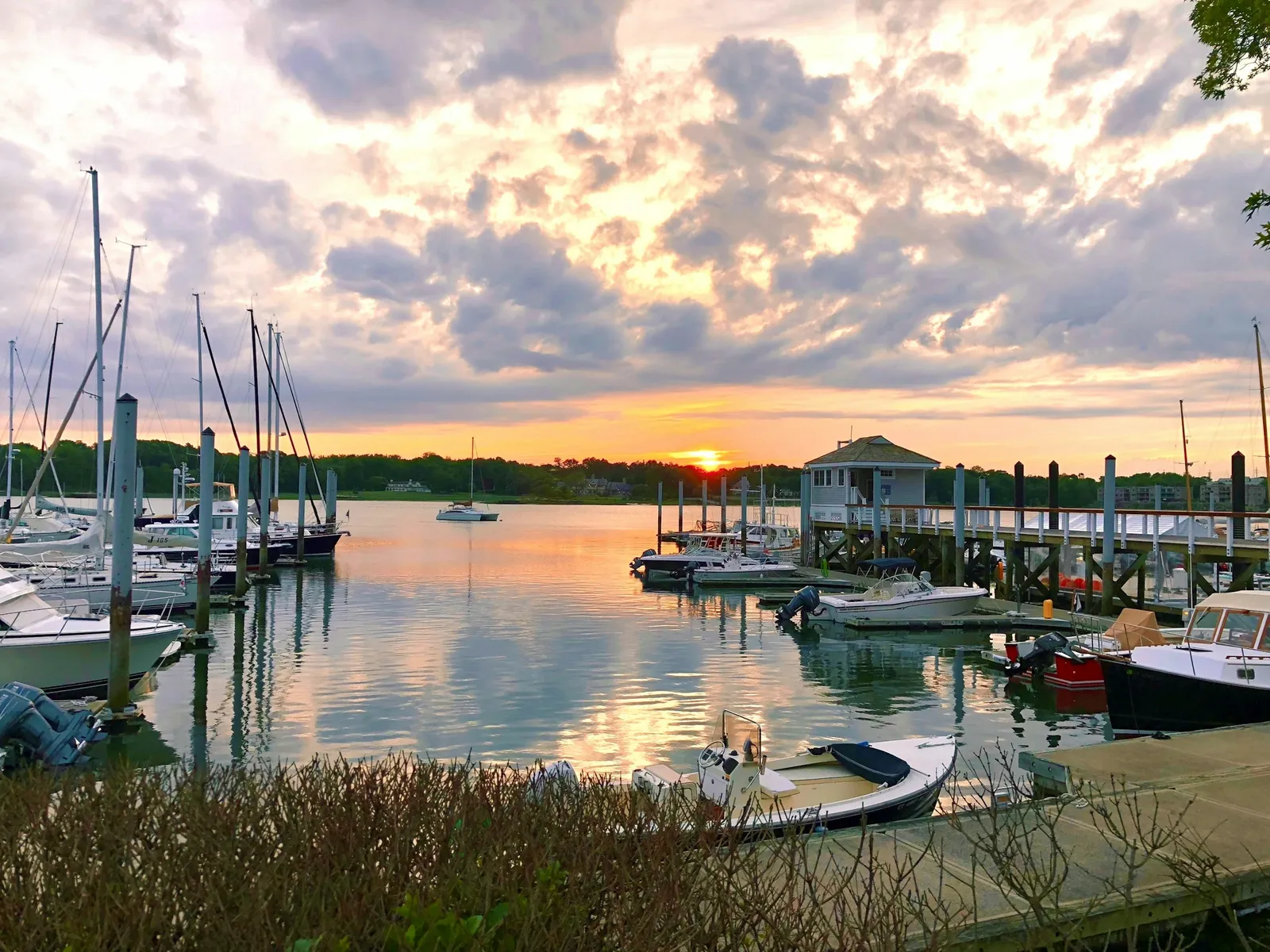
What makes a shoreline home in these towns different to insure?
Three things, mostly. First, you’re exposed to both wind and water, and those sit on different policies. Second, a lot of the housing near the water is old: shingle cottages, converted summer places and houses that have been added onto over decades. Third, the water itself is creeping up. NOAA’s tide gauge at Bridgeport shows relative sea level rising about 1.35 inches per decade from 1964 through 2025, which works out to roughly eight inches over that span. Higher baseline water means a smaller storm can reach farther.
None of that makes these houses uninsurable, but the details matter more. Our broader guide to coastal home insurance in Connecticut covers the statewide picture. This post stays local.
Who pays when a storm hits: my homeowners policy or flood insurance?
It depends on what caused the damage. The Connecticut Insurance Department spells it out: a homeowners policy covers windstorm loss no matter how the storm is classified, and it excludes flood. The table below is a general guide.
| Storm damage | Usually handled by | What to ask your agent |
|---|---|---|
| Wind tears off shingles or siding | Homeowners policy, after your deductible | Do I have a separate wind/hail or hurricane deductible? |
| Tree blown onto the house | Homeowners policy, including removal from the house | Is there a limit on tree removal? |
| Storm surge floods the first floor | Flood policy (NFIP or private) | What are my building and contents limits? |
| Water in the basement from rising water | Flood policy, with basement limits | What does my flood policy cover below the first floor? |
| Power out for days, house undamaged | Generally not covered for hotel costs | Do I have any food spoilage coverage? |
When does the hurricane deductible apply?
Connecticut is stricter about this than many states. According to the CID, an insurer can apply a hurricane deductible only from the time the National Hurricane Center issues a hurricane warning for any part of the state, and only if the hurricane brings sustained winds of 74 mph or more somewhere in Connecticut. The window closes 24 hours after the last warning ends or the storm is downgraded. Windstorm or hail deductibles can be offered, but insurers can’t mandate them. Our post on hurricane deductibles in Connecticut shows where to find yours.
How many shoreline homes here carry flood insurance?
FEMA publishes the number of NFIP flood policies in force for every community. Here’s the shoreline from West Haven east to Old Saybrook:
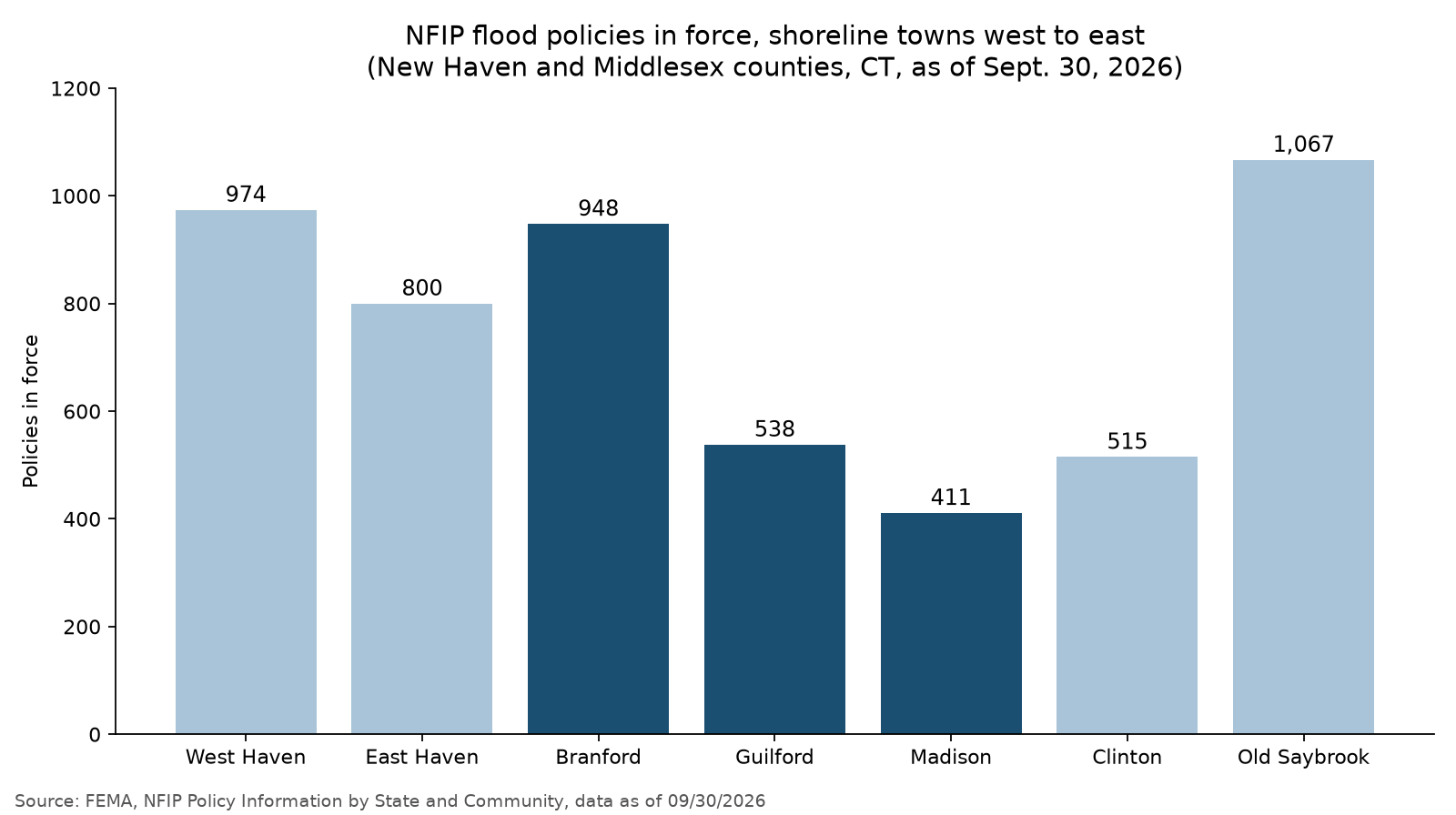
Branford leads the three towns with 948 policies, then Guilford with 538 and Madison with 411. A low count reflects who bought NFIP coverage, often because a lender required it, not how much flood risk a town has. Private flood policies aren’t counted here.
What should I check in Branford, Guilford and Madison?
Branford
Branford’s shoreline runs from Short Beach and Indian Neck out to Stony Creek, with the Thimble Islands just offshore. Island and point properties raise questions an underwriter will ask: how fire crews reach the house, whether it’s seasonal or year-round, and how it’s heated. Have those answers ready.
Guilford
Guilford has thought about this longer than most towns. CT Mirror reported in 2013 that its Community Coastal Resilience Plan looked decades ahead at sea level rise, and that Seaside Avenue floods not only in big storms but in nor’easters and astronomical high tides (CT Mirror, “Guilford takes the long view on climate change,” November 4, 2013). By 2018, the New Haven Register reported the town had raised Old Quarry Road, Tuttle’s Point Road and Chaffinch Island Road, and that some newer houses near Jacobs Beach were built with living space above FEMA’s requirements (New Haven Register, “Connecticut and towns still working to prepare for floods, rising seas,” September 14, 2018). If you own an elevated house, make sure your agent knows. It can matter for flood options. For larger or historic Guilford homes, see Guilford, CT high-value home insurance.
Madison
Madison’s shoreline mixes year-round homes with summer cottages along the beaches, with Hammonasset Beach State Park at the east end. Seasonal use is the big question here. A house that sits empty from October to May needs a policy written for how it’s actually used, and heat, water shutoff and regular checks matter all winter. For larger shoreline homes, see Madison, CT high-value home insurance.

“On the shoreline, the questions that matter most are flood and wind. Does your homeowners policy have a separate hurricane deductible, and do you have flood coverage at all? Most people find out the answers after a storm. We’d rather you know them now.”
Do I need an elevation certificate?
Start by looking up your flood zone on FEMA’s Flood Map Service Center. An elevation certificate is a form completed by a licensed surveyor or engineer that records how high your lowest floor sits. It isn’t always required to buy flood coverage today, but it can help, especially for an elevated house. Ask the seller or the town whether one already exists.
Elevation also comes up after a big loss. The New Haven Register piece notes that homes being improved by more than half their value have to meet current elevation rules. If storm repairs cross that line, the town can require the house to be raised, so ask how your policies handle code-required upgrades.
Is replacement cost enough for an older shoreline house?
Only if the dwelling limit is right. Replacement cost pays to rebuild with similar materials, but it’s capped at your Coverage A limit. Cedar shingles, plaster walls and custom trim on an old cottage often cost more to replace than the house’s market value suggests,. Before renewal, check these:
- Dwelling limit: based on current rebuilding cost, not purchase price or tax assessment.
- Deductibles: your all-perils deductible, any wind/hail deductible and the hurricane percentage, all on the declarations page.
- Code upgrades: whether your policy pays to bring a damaged house up to current building and elevation rules.
- Flood policy: building and contents limits, and what’s covered in a basement or below an elevated floor.
- Occupancy: primary, secondary or seasonal, described accurately.
- Documents: elevation certificate, roof age and recent updates on file with your agent.
How we shop shoreline homes
We’re an independent agency, so we compare Connecticut homeowners policies from Vermont Mutual, Andover Companies, Providence Mutual, Liberty Mutual, Foremost, Openly, Stillwater, Cincinnati, National General and Hanover. For flood, we place NFIP policies through Selective and also compare private flood options from Flow Flood, Neptune Flood, Beyond Floods, The Flood Insurance Agency, CatCoverage and Aon Edge. Each carrier has its own appetite for coastal homes, so which ones fit depends on the house. Our Connecticut homeowners insurance page has more on how we work.
One date to keep in mind: as of FEMA’s most recent update we’ve seen, the NFIP is authorized through December 11, 2026. If Congress lets that lapse, FEMA can’t sell new NFIP policies until it acts. Private flood isn’t tied to that deadline.
Frequently asked questions
Does homeowners insurance in Branford cover flood damage?
No. A standard Connecticut homeowners policy excludes flood, including storm surge and water from an overflowing stream. The Connecticut Insurance Department says you need a separate flood policy for that, either through the NFIP or a private flood insurer.
Is hurricane wind damage covered on a Connecticut homeowners policy?
Yes. The Connecticut Insurance Department says a homeowners policy covers windstorm loss whether the storm is called a hurricane, tornado or something else. What changes is the deductible: a hurricane deductible can apply only during the window Connecticut law allows.
Do I need an elevation certificate for a house in Guilford or Madison?
Not always to buy a policy, but it can help. An elevation certificate is a surveyor’s record of how high your lowest floor sits relative to expected flood levels. Ask your agent whether one exists for your house and whether it would help with the flood options available to you.
Can I buy flood insurance right before a storm?
Generally, no. The Connecticut Insurance Department notes that you normally can’t buy a flood policy immediately before or after a flood or hurricane, and NFIP policies usually have a waiting period before they take effect. Set it up well before storm season.
Will my homeowners policy pay for a hotel if the power is out after a storm?
Generally, no. The Connecticut Insurance Department says additional living expense coverage applies when a covered loss damages your home and makes it unfit to live in, not when a widespread outage cuts power to an undamaged house.
Sources
- Connecticut Insurance Department, “Homeowners Storm Claims”
- NOAA Tides & Currents, “Relative Sea Level Trend, 8467150 Bridgeport, Connecticut”
- FEMA, “NFIP Policy Information by State and Community,” data as of September 30, 2026
- FEMA Flood Map Service Center
- FEMA, “Congressional Reauthorization”
- New Haven Register, “Connecticut and towns still working to prepare for floods, rising seas” (Sept. 14, 2018)
- CT Mirror, “Guilford takes the long view on climate change” (Nov. 4, 2013)
Reviewed by Jon Merwin, Founder and CEO, Licensed Insurance Advisor.
Portsmouth Atlantic Insurance has 1,000+ Google reviews and over 2,000 testimonials.
Related guides: Hurricane Deductibles in Connecticut · Coastal Home Insurance in Connecticut · Home Insurance Cancelled Because of Roof?
Next step: see our Connecticut homeowners insurance options.