Flood · CT
By Jon Merwin, Founder and CEO, Licensed Insurance Advisor
Published: October 22, 2026 · Updated: October 23, 2026
- Since July 1, 2025, Connecticut’s seller disclosure report includes a “Flood Risk Awareness” section with six questions about flood zones, claims, disaster aid, elevation certificates and past water damage.
- Since July 1, 2026, mortgage lenders must give buyers a signed written notice, at least 10 days before closing, that homeowners insurance doesn’t cover flood.
- New and renewing homeowners, condo, renters and dwelling fire policies effective on or after July 1, 2026 must carry a plain-language notice that flood isn’t covered.
- A disclosure tells you a home’s flood history. It doesn’t insure it. Flood coverage is still a separate policy.
For years, Connecticut asked home sellers exactly one flood question: is the property in a flood hazard area or an inland wetlands area? Public Act 25-33 changed that. As of October 16, 2026, sellers answer six more flood questions on the state’s disclosure report, lenders must warn buyers in writing before closing that homeowners insurance doesn’t cover flood, and insurers have to print the same warning on homeowners and renters policies. If you’re buying or selling in Milford, Stratford, Fairfield or anywhere else along Long Island Sound, here’s what each piece means and what to do with it.

What does Connecticut’s flood disclosure law require?
Public Act 25-33 was a large climate-resilience bill from the 2025 session (Senate Bill 9). Three of its sections reach into a home sale, and they kick in at different times for different people.
| Who | What they must give you | When | In effect since |
|---|---|---|---|
| The seller | Answers six flood questions on the Residential Property Condition Report and receives a printed flood-risk notice on the form | Before the buyer signs a binder, contract, option or lease with a purchase option | July 1, 2025 |
| The mortgage lender | Gives a written notice that homeowners insurance doesn’t cover flood, that flooding can happen outside a mapped flood zone, and that you may want to talk to a licensed insurance producer; you sign and date it | At least 10 days before closing | July 1, 2026 |
| Your insurance company | Includes a plain-language notice that the policy doesn’t cover flood and that separate flood insurance is available | On new and renewal homeowners, condo, renters and dwelling fire policies | July 1, 2026 |
What flood questions do Connecticut sellers have to answer?
The Department of Consumer Protection’s Residential Property Condition Report (revised 07/2025) now has a section called “Flood Risk Awareness,” questions 60 through 65. Each one gets a yes, no, unknown or not applicable checkbox.
- Is the property in a FEMA-designated floodplain? If yes, which zone?
- While you’ve owned it, did you (or, as far as you know, any earlier owner) get FEMA, SBA or other federal or state disaster assistance for flood damage?
- Is a flood insurance policy in effect on the property right now?
- Is a FEMA elevation certificate available?
- Have you ever filed a claim for flood damage to the property?
- Has the structure had water penetration or damage from seepage or a natural flood event?
Paraphrased from section I of the Connecticut DCP Residential Property Condition Report. Use the official form for the exact wording.
Below the seller’s signature, the form now prints a short notice: federal law requires flood insurance on federally backed mortgages in high-risk zones, a flood insurance requirement tied to past federal disaster aid stays with the property for future owners, and FEMA maps aren’t designed to be a reliable tool for buyers to judge flood risk.
The report covers homes of one to four units, including condos and co-ops, whether or not a broker is involved. Sellers who skip the disclosure may face consequences at closing and should ask their attorney what that means for the deal. A few kinds of transfers are exempt from the report, so confirm whether yours might be one.
If you’re selling
Pull your flood policy’s declarations page, any elevation certificate and records of past claims or FEMA help before you list. “Unknown” fits only when you truly don’t know. If the basement took water in a nor’easter, that belongs on the form. Your listing agent or attorney can help with wording.
What should buyers do with the answers?
The form itself says the seller’s answers aren’t a warranty and don’t replace inspections. A few steps make the flood section useful:
- Check the zone yourself. Type the address into the FEMA Flood Map Service Center and compare it with the seller’s answer.
- Ask for the elevation certificate. If one exists, it can help when you price NFIP or private flood coverage.
- Follow up on any “yes” to past claims or disaster aid. Ask when it happened and what was repaired. If federal disaster aid was paid, flood insurance may have to stay in place no matter who owns the home.
- Get a flood quote while you can still act on it. Ideally that’s before your inspection and mortgage contingencies run out, not the week of closing.
The law came after real pressure. In January 2025, CT Mirror and Connecticut Public reported that a Natural Resources Defense Council study gave Connecticut a D for flood disclosure and found that more than 2% of the state’s single-family homes had flooded since 2010. At the time, sellers only had to say whether a home was in a flood hazard area.

“If you’re buying near the water in Connecticut, ask about flood the same day you ask about the inspection. The disclosure tells you the history, and a quote tells you what it’ll cost to protect.”— Jon Merwin, Founder and CEO, Licensed Insurance Advisor
What will my lender and insurer send me?
If you’re financing, expect a separate flood notice from your lender at least 10 days before closing. You sign and date it, and the lender keeps a copy. When that page shows up, it’s your cue to settle flood coverage if you haven’t.
Current owners will see the change too. The Insurance Department’s Bulletin PC-93-25 told insurers to file their notice wording by January 31, 2026, for new and renewal policies effective on or after July 1, 2026, and to put it on the declarations page if they can. That includes condo and dwelling fire policies. If your home or condo policy renewed this summer, look at your declarations page. The notice doesn’t change your coverage.
How many homes near Stratford and Milford have flood insurance?
FEMA’s count of National Flood Insurance Program policies in force, data as of September 30, 2026, shows 14,105 in Fairfield County and 8,000 in New Haven County. Together, that’s about 72% of Connecticut’s 30,648 NFIP policies. Milford leads the two counties with 2,410, followed by Stamford (2,294) and Fairfield (2,240). Stratford has 1,615.
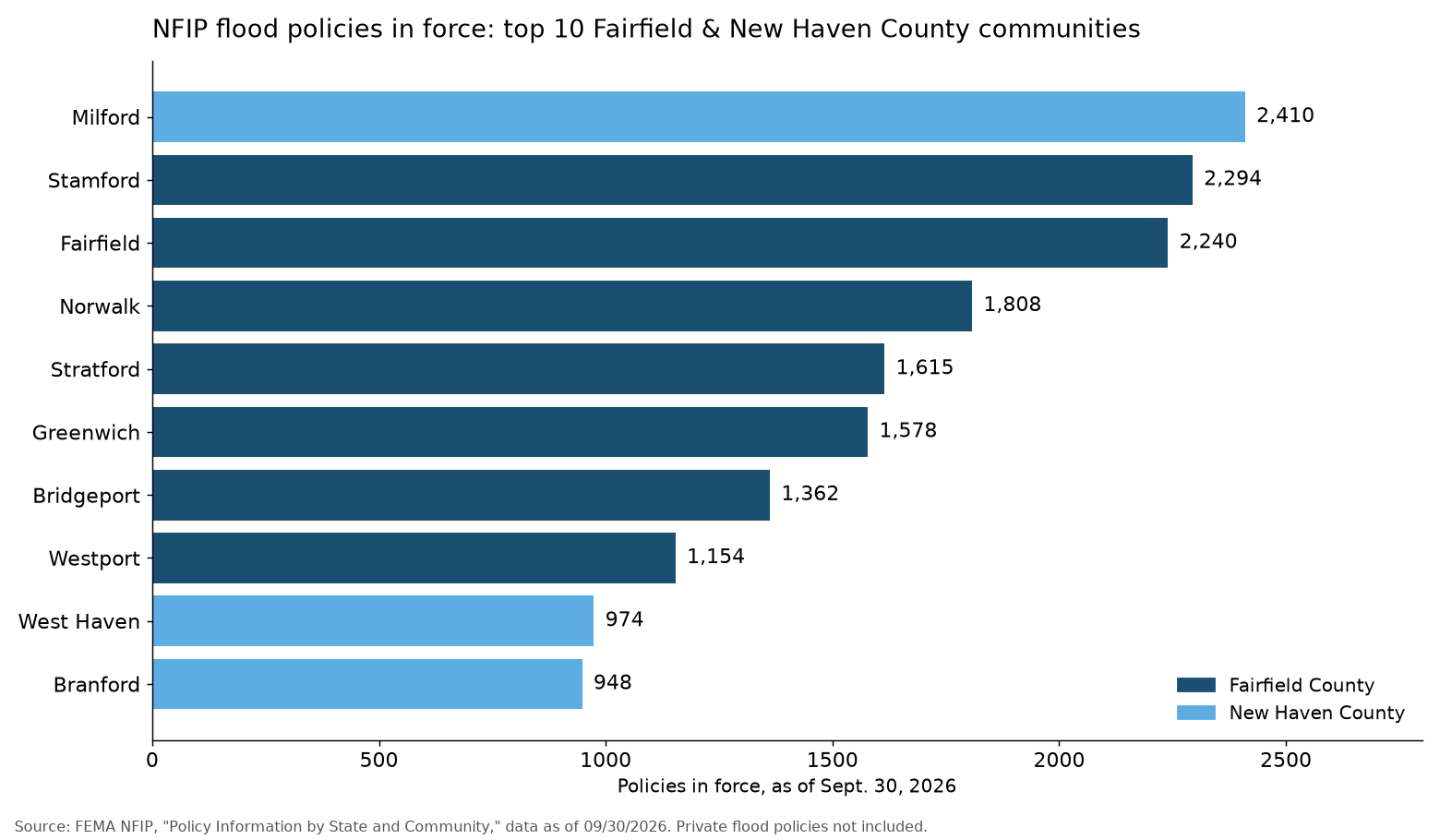
The rankings track the coastline. Stratford sits where the Housatonic River meets the Sound, and the same CT Mirror report noted a state Department of Transportation plan for a cofferdam system on Route 113 in Stratford. Our guide to coastal home insurance in Connecticut covers how flood and wind risk shape shoreline policies.
Where can I get flood insurance in Connecticut?
A standard Connecticut homeowners policy won’t pay for flood, so flood coverage is its own policy. We place NFIP policies through Selective, a write-your-own carrier for the federal program, and we also quote private flood carriers, including Flow Flood, Neptune Flood, Beyond Floods, The Flood Insurance Agency, CatCoverage and Aon Edge. If you have a mortgage, confirm your lender will accept a private policy before you choose one. For town-level detail, see our page on flood insurance in Fairfield, CT.
Closing in December? As of October 16, 2026, FEMA says Congress has authorized the NFIP only through December 11, 2026. If that lapses, FEMA stops selling and renewing policies until Congress acts, which can hold up closings that need flood coverage. Our post on the December 11 flood insurance deadline explains the options.
Frequently asked questions
When did Connecticut’s new flood disclosure rules take effect?
The six flood questions on the seller’s property condition report took effect July 1, 2025. The lender notice and the insurer notice that homeowners and renters policies don’t cover flood took effect July 1, 2026.
Do Connecticut sellers have to disclose past flood damage?
They have to answer whether they ever filed a flood claim on the property and whether the structure has had water penetration or damage from seepage or a natural flood event. They also answer whether they know of federal or state disaster aid for flood damage, whether a flood policy is in force and whether an elevation certificate is available.
What happens if the seller doesn’t give me the disclosure report?
Sellers who skip the disclosure may face consequences at closing under Connecticut General Statutes section 20-327c. Ask your attorney what that means for your deal.
Does homeowners insurance cover flood in Connecticut?
No. Standard homeowners, condo and renters policies exclude flood, and Public Act 25-33 now requires insurers to say so in a plain-language notice. Flood coverage is a separate policy, from the NFIP or a private flood carrier.
If a house isn’t in a FEMA flood zone, do I still need flood insurance?
Your lender may not require it, but the state’s own disclosure form warns that a property doesn’t have to be near water or in a flood zone to flood. It’s worth pricing a policy either way.
Sources
- Connecticut General Assembly, Public Act No. 25-33 (Substitute Senate Bill No. 9), 2025 session
- Connecticut Insurance Department, Bulletin PC-93-25, “Flood Insurance Disclosure Requirements Under Public Act No. 25-33,” July 8, 2025
- Connecticut Department of Consumer Protection, Residential Property Condition Report (revised 07/2025)
- FEMA NFIP, “Policy Information by State and Community,” data as of Sept. 30, 2026
- FEMA, “Congressional Reauthorization for the National Flood Insurance Program” (updated Sept. 28, 2026)
- CT Mirror / Connecticut Public, “CT home flood repair costs are the highest in the nation, study finds,” Jan. 24, 2025
Reviewed by Jon Merwin, Founder and CEO, Licensed Insurance Advisor.
Portsmouth Atlantic Insurance is New Hampshire’s highest-rated agency on Google, with 1,000+ Google reviews and over 2,000 testimonials.
Related guides: Flood Insurance Deadline Dec. 11, 2026 · Coastal Home Insurance in Connecticut: Flood and Wind · Everything You Need to Know About Home Insurance Binders
Next step: see our flood insurance options for Connecticut homes.