
Home · NH
Reviewed by Jon Merwin, Founder and CEO, Licensed Insurance Advisor
Published: [SET AT PUBLISH] · Updated: November 2, 2026
- The outage itself usually isn’t covered. Damage from a covered event at your home, like a falling tree or a burst pipe, usually is.
- Spoiled food is often covered only if you added a food spoilage or refrigerated property endorsement.
- Lightning surges are commonly covered; other surges often need equipment breakdown coverage.
- A failed sump pump needs water backup coverage, which standard NH policies exclude.
- In 2025 the average Eversource customer in New Hampshire was without power for about 160 minutes, according to federal EIA data.
The freezing rain started Sunday night, and by Monday morning half the street was dark. When an ice storm hit central and northern New Hampshire on December 29, 2025, NHPR reported that tens of thousands of customers lost power, and crews were still working on the last few thousand the next morning. So what does your homeowners policy actually do when the lights go out? Here’s the short answer, as of November 2, 2026: most policies don’t pay for the outage itself, but they often do pay for physical damage at your home caused by a covered event during it. The details, like spoiled food, power surges and a dead sump pump, are where people get surprised.
Does homeowners insurance cover a power outage?
Not on its own. Many homeowners policies are written with a power failure exclusion for outages that start off your property, like a transformer that blows two streets over or a line that comes down on Route 1.
The picture changes when the outage leads to damage that a covered peril causes at your home. A few common New Hampshire examples:
- A tree comes down on the house. The New Hampshire Insurance Department says your own insurer generally pays to repair your home no matter whose yard the tree came from.
- The furnace quits and a pipe bursts. Sudden water damage from a burst pipe is usually covered, though policies expect reasonable care to keep the house heated.
- A fire starts from a candle, a space heater or a generator. Fire is a covered peril on standard policies.
Covered, often excluded, and worth asking about
| What happened | How policies often treat it | What to ask your agent |
|---|---|---|
| Power is out for two days, no damage to the house | Generally not covered | Does my policy have a power failure exclusion? |
| Freezer full of food spoils | Often not covered unless you added an endorsement | Can I add food spoilage or refrigerated property coverage? |
| Lightning surge damages the TV and furnace controls | Commonly covered, minus your deductible | Are my electronics covered at replacement cost? |
| Surge when the power comes back damages appliances | Often limited or excluded | Would equipment breakdown coverage help here? |
| Sump pump stops and the basement takes on water | Excluded on standard policies | Do I have water backup coverage, and what is the limit? |
| Tree falls on the roof during an ice storm | Generally covered | What is my deductible for wind or storm damage? |
Is spoiled food covered after an outage?
On a lot of policies, the answer is no if the outage started off your property. Some carriers sell a food spoilage or refrigerated property endorsement that pays up to a set limit when food goes bad because the power or the fridge failed, and some higher-end home policies build it in. It’s a small piece of coverage, but if you keep a chest freezer in the garage full of venison or striped bass, it’s worth a look.
What about power surges and fried electronics?
Lightning is a covered peril on most homeowners policies, so a surge from a lightning strike is commonly covered. Surges from other causes are trickier. When power flickers back on after a storm, the spike can damage furnace boards, well pumps, refrigerators and computers, and many policies limit or exclude that kind of electrical damage. That’s the gap equipment breakdown coverage on a homeowners policy is designed to fill.

[QUOTE NEEDED FROM Jon Merwin]
How often does the power go out in New Hampshire?
Often enough to plan for it. Every year, utilities report reliability numbers to the U.S. Energy Information Administration. The key one is SAIDI, the average number of minutes each customer goes without power over the year. In 2025, the three investor-owned utilities in New Hampshire that report under the standard IEEE method looked like this:
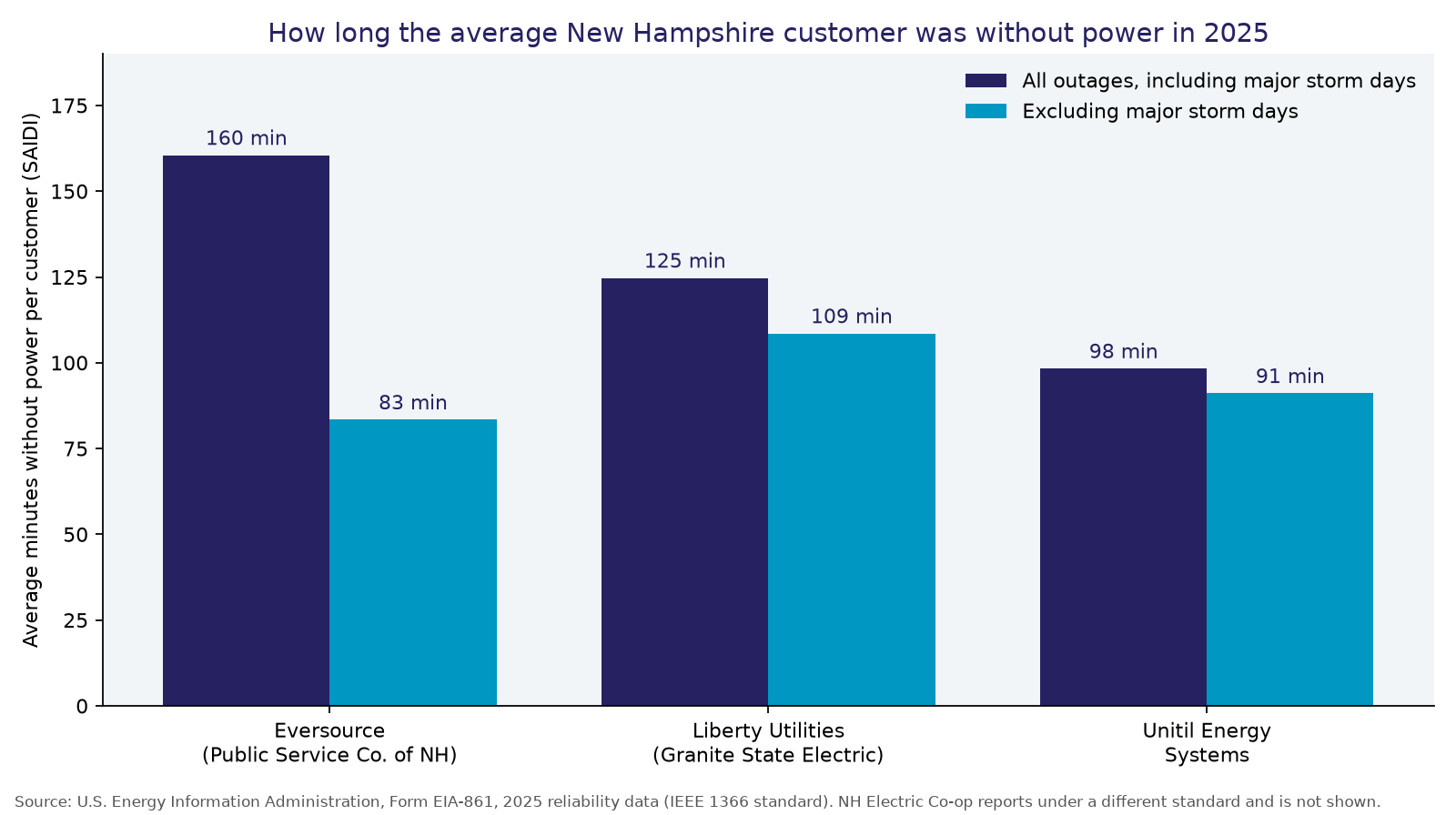
Look at the gap between the two Eversource bars. Excluding major storm days, the average customer lost about 83 minutes of power in 2025. Counting them, it was about 160. In other words, a handful of big storms did roughly as much damage to reliability as the whole rest of the year.
We’ll check your food spoilage, surge and water backup coverage with you before winter. Talk to our Portsmouth team: (603) 431-4020 or see our New Hampshire homeowners coverage.
Does homeowners insurance cover a generator?
A portable generator you own is usually treated like your other personal property, and a permanently installed standby generator is usually treated as part of the house. If you install a standby unit, tell your agent, since it adds value to the home and may change your dwelling limit.
The bigger issue is safety. A policy can’t undo a carbon monoxide poisoning. During the December 2025 storm, New Hampshire emergency managers reminded residents to never run a generator inside a building or enclosed space and to keep it 20 feet from buildings with the exhaust pointed away, according to NHPR.
- Read your policy for three things: food spoilage, water backup and equipment breakdown. If any is missing, ask about adding it.
- Test the sump pump and think about a battery backup or water alarm.
- Keep the generator outside, at least 20 feet from the house, exhaust pointed away. Never in the garage or basement.
- Use a transfer switch installed by a licensed electrician. Never plug a generator into a wall outlet.
- Put CO alarms on every floor and check the batteries.
- Use flashlights, not candles, wherever you can.
- Keep the oil or propane topped up so the heat comes right back once power does.
- Take photos of the freezer contents and your electronics now. It makes a claim much easier later.
Generator spacing from NH emergency management guidance as reported by NHPR, checked November 2, 2026.
My sump pump stopped and the basement flooded. Now what?
This one catches a lot of Seacoast homeowners, especially in older houses with fieldstone foundations. The New Hampshire Insurance Department is clear that standard homeowners policies exclude water that backs up through sewers, drains or sump pumps, and that many companies offer an endorsement to add it. If your basement is finished, or your furnace and water heater live down there, that endorsement matters. Our guide to sewer backup insurance explains how it works, and our tips on preventing water damage to your home cover the rest.
Will I get money for a hotel if the power is out for days?
Usually not for the outage alone. Additional living expense, also called loss of use, generally pays your extra costs when a covered loss makes the house unlivable, or when a government order keeps you out, per the New Hampshire Insurance Department. If a tree comes through the roof, that’s a covered loss and the hotel may be covered. A cold, dark but undamaged house usually isn’t.
We’re an independent agency, so if your current policy is missing pieces you want, we can compare options from 40+ carriers. Our New Hampshire homeowners insurance page explains how we shop it, and our look at how insurers handle snow and ice damage in the Northeast covers the roof side of winter.
Frequently asked questions
Does homeowners insurance cover a power outage in New Hampshire?
Not the outage itself. Many homeowners policies exclude loss caused by a power failure that starts away from your property, such as a downed line down the road. What’s often covered is damage from a covered event that happens at your home, like a tree falling on the house, a fire, or a pipe that bursts while the heat is out. Your policy wording decides it.
Will my homeowners policy pay for food that spoiled when the power went out?
Usually only if you added coverage for it. Some carriers offer a refrigerated property or food spoilage endorsement with its own limit, and some higher-end home policies include it. Without one, food lost to an off-premises outage is often not covered. Ask your agent what your policy says.
Are power surges covered by homeowners insurance?
A surge caused by lightning is commonly covered, because lightning is a covered peril on most policies. Surges from other causes, such as a utility problem when the power comes back, are often limited or excluded for electronics and appliances unless you have equipment breakdown coverage.
If my sump pump stops during an outage and the basement floods, am I covered?
Not under a standard policy. The New Hampshire Insurance Department notes that most policies exclude water that backs up through sewers, drains or sump pumps, but many companies offer an endorsement to add it for an additional premium.
Sources
- New Hampshire Insurance Department, “Homeowners and Renters Insurance”
- National Association of Insurance Commissioners, “Homeowners Insurance”
- U.S. Energy Information Administration, “Annual Electric Power Industry Report, Form EIA-861 detailed data files” (2025 reliability data)
- NHPR, “Storm update: Freezing rain causes thousands of power outages, slick roads across NH,” Dec. 29, 2025
We compare homeowners policies from 40+ carriers and don’t charge any agency or broker fees on personal lines. Talk to our Portsmouth team: (603) 431-4020 or email insure@portsmouthatlanticins.com.
Reviewed by Jon Merwin, Founder and CEO, Licensed Insurance Advisor.
Portsmouth Atlantic Insurance has 1,000+ Google reviews and over 2,000 testimonials.
Related guides: What Is Equipment Breakdown Coverage on a Homeowners Insurance Policy? · What Is Sewer Backup Insurance? · Which Insurance Companies Handle Snow and Ice Damage Best in the Northeast?
Next step: see our New Hampshire homeowners insurance options.
Related reading: our guides on homeowners insurance and ice storms in NH and CT.