
Connecticut · Independent Agency
Coastal Home Insurance in Connecticut – Flood, Wind, and What Homeowners Often Miss
Connecticut’s shoreline-from the New York border through Fairfield County and east along Long Island Sound-looks great on a summer weekend. Insurance-wise, it’s messy. Homes near the Sound, tidal rivers, and coastal wetlands face wind, storm surge, and heavy-rain flooding that a single “standard” homeowners policy was never built to handle alone.
We serve Connecticut from our Connecticut office and by phone, email and online. We’re independent. We help shoreline and near-shore homeowners compare personal coverage across 40+ carriers, including flood markets we represent. We work for you-not one insurance company.
This page is for Connecticut coastal and Sound-adjacent homes. Our Seacoast New Hampshire flood page covers New Hampshire separately-same agency, different local risks.
Start Your Quote
Get Your Home Insurance Quote
Homeowners vs. Flood vs. Wind
Why Coastal Connecticut
Needs Its Own Insurance Conversation
Fairfield County and the broader CT shoreline aren’t generic Northeast suburb risks:
Long Island Sound Exposure
Nor’easters and tropical systems drive wind, wind-driven rain, and surge into low-lying streets, marshes, and homes a few blocks inland-not only waterfront lots.
Wetlands and Tidal Influence
Properties near coastal wetlands, coves, and tidal rivers can see water paths that surprise owners who thought they were “far enough from the beach.”
Older and Renovated Housing Stock
Many Stratford-area and shoreline homes have been updated over decades. Roof age, electrical/plumbing updates, and rebuild complexity all affect how carriers underwrite coastal risks.
Rebuild and Code Pressure
After a serious loss, elevation rules, coastal construction standards, and contractor availability can raise the cost to make a home whole again. Dwelling limits and ordinance-or-law belong in a coastal review.
Wind Deductible Structures
On many coastal policies, storm-related wind may use a percentage deductible (tied to dwelling coverage). That’s a different out-of-pocket conversation than a flat-dollar deductible for a kitchen fire.
Stratford-specific homeowners shopping (rebuild limits, water backup, buyers, landlords): Homeowners Insurance in Stratford, CT. Statewide CT homeowners: Homeowners Insurance in Connecticut.
Not Sure Which Coastal Risks Apply to Your Home?
Homeowners vs. Flood vs. Wind
Homeowners vs Flood vs Wind –
Keep the Categories Straight
Getting this wrong before a storm is expensive. Simplified direction (always confirm on your forms):
| Scenario | Often addressed by homeowners? | Often needs a separate flood policy? |
| Burst pipe / sudden internal plumbing failure | Frequently yes (policy-dependent) | No |
| Storm surge / tidal flood / many external rising-water events | Typically no | Yes |
| Wind damage to roof, siding, or windows | Often yes – subject to wind / storm deductible rules | No |
| Wind-driven rain through a storm-created opening | Sometimes (HO / wind wording) | Depends-ask us |
| Heavy rain / groundwater entering from outside as flood | Often treated as flood → typically no on HO | Yes |
| Sewer / drain backup | Often needs water-backup endorsement | Separate from flood |
Core rule: Standard homeowners insurance generally does not cover flood damage from rising or external water. Flood protection usually requires a separate flood policy-through the National Flood Insurance Program (NFIP) and/or private flood markets, depending on the property and lender needs.
Want Help Sorting Out Homeowners, Flood, and Wind?
Hurricane & Storm Deductibles
Hurricane and Named-Storm Deductibles
(What to Ask Before Storm Season)
On coastal Connecticut homeowners policies, the deductible for a kitchen fire is often not the same structure that applies to a major wind event.
Many carriers use a percentage of dwelling coverage for hurricane, named-storm, or wind/hail triggers-commonly discussed in the industry in ranges such as 1%, 2%, or 5% of Coverage A (exact triggers and percentages are carrier- and policy-specific). On a higher-value shoreline home, that can mean a much larger out-of-pocket amount than a flat deductible.
Ask us to walk through, in plain English:
- Which trigger language applies (hurricane vs named storm vs wind/hail)?
- Is the storm deductible a percentage or a flat dollar amount?
- How does that interact with your flood policy if surge and wind both occur?
- Are there mitigation credits (roof age/type, opening protection, etc.) worth documenting?
There is no single “best” deductible for every Sound-area home. The right structure depends on the property, carrier appetite, and your comfort with retention.
Know What Your Storm Deductible Means in Dollars
Flood Insurance Options
Flood Options at a High Level –
NFIP, Private, and Higher-Limit Needs
NFIP (National Flood Insurance Program)Available in participating Connecticut communities (virtually all CT municipalities participate). Building and contents limits follow NFIP program rules. Public materials commonly cite residential building coverage up to $250,000 and contents up to $100,000 under standard NFIP residential structures-confirm current program limits at quote time. Waiting periods commonly apply when flood isn’t purchased with a lender-required closing (often discussed as about 30 days-verify current rules when you quote).
Private flood
Private markets may offer different limits, deductibles, waiting periods, and optional coverages depending on eligibility. Some homeowners use private flood when they need higher building limits than NFIP residential caps, different timing for a closing, or optional features that vary by market.
Excess / layered approaches
Higher-value shoreline homes sometimes need more than a single baseline flood limit. An agent can discuss whether NFIP, private primary, excess flood, or a combination better matches rebuild exposure.
Start Your Quote
What We Typically Compare for Connecticut Coastal Clients:
Building vs Contents Needs
We review coverage for the home itself and the personal property inside it. Higher-value homes may require closer attention to contents limits.
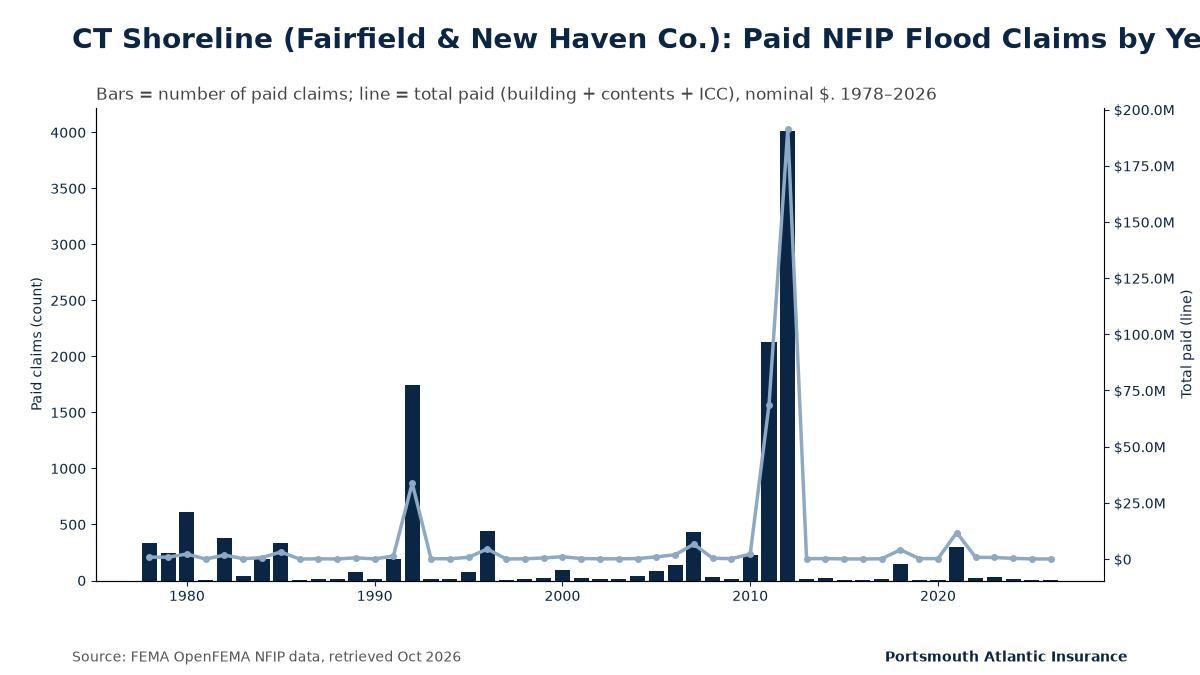
Across 11 Connecticut shoreline towns, FEMA records show 12,626 paid NFIP flood claims totaling about $343.8 million since 1978, with 2011 and 2012 accounting for about $259.8 million of that.
Key Factor
Waiting Period and Purchase / Refinance Closing Dates
If you are buying or refinancing, timing matters. We review applicable waiting periods against your closing date.
Key Factor
Deductibles and Basement / Below-Grade Limitations
We compare deductibles and review limitations that may apply to basements and below-grade areas.
Key Factor
Lender Acceptance (NFIP vs Private Placement Rules)
If flood insurance is required, we review whether the available policy meets your lender’s requirements. This can include comparing NFIP and private flood options.
Key Factor
How Flood Interacts with Homeowners Wind Deductibles and Umbrella Liability
Flood and wind coverage address different risks, so it is important to understand how they fit with your homeowners policy. We also consider where umbrella liability fits into the broader insurance picture.
Key Factor
Whether Ordinance-or-Law and Water-Backup Conversations Belong in the Same Review
Depending on the property, water backup and ordinance-or-law coverage may also warrant review. These coverages can address risks that fall outside a standard flood policy.
Key Factor
Who Should Review Coastal Coverage?
Who Should Review
Coastal Coverage Now?
Consider a focused coastal review if you:
- Own or are buying near Long Island Sound, a tidal river, coastal wetlands, or a street that ponds in heavy rain
- Have a lender flood determination (required or not-requirement ≠ full risk picture)
- Live outside a mapped high-risk zone but still worry about surge, drainage, or basement water after storms
- Carry a homeowners policy with a percentage storm deductible you have never calculated in dollars
- Renovated, elevated, or added value since the last full insurance review
- Own a higher-value or custom shoreline home where NFIP-style caps may not match rebuild reality-see also high net worth insurance
- Are a landlord or condo owner coordinating unit vs association vs flood questions
We don’t tell every Connecticut household they must buy flood. We do encourage Sound-area owners to make an informed decision instead of assuming “my homeowners policy covers the storm.”
Shoreline Communities
We Commonly Help
We serve Connecticut from our Connecticut office and by phone, email and online.Phone: (203) 859-6858
Email: insure@portsmouthatlanticins.com
We regularly talk with homeowners and buyers in and around:
- Stratford (including shoreline and wetland-adjacent neighborhoods)
- Milford
- Fairfield
- Westport and Southport
- Broader Fairfield County near-shore and inland clients who still want Sound-aware advice
Insuring a home on the New Hampshire Seacoast? See our Seacoast NH flood insurance page.
How We Help Coastal Connecticut Clients
How Portsmouth Atlantic
Helps Coastal Connecticut Clients
- Gather address, year built / updates, roof details you’re aware of, claims history you’re comfortable sharing, and lender flood paperwork if purchasing.
- Separate the conversation into homeowners (incl. wind deductibles), flood, and any water-backup / ordinance
- Compare available options across carriers we represent.
- Explain tradeoffs in plain language-you choose, with no obligation to move every policy at once.
- Stay available for endorsements, renewals, and post-storm questions.
Portsmouth Atlantic Insurance has been an independent agency since 2005, with over 2,000 client testimonials.
Multiple Carriers, One Conversation
Instead of calling several different companies, we compare policies from 40+ carriers on your behalf.
Local Advisors Who Know Coastal Connecticut
Our team understands the insurance needs of homeowners along the Connecticut shoreline and across Fairfield County.
Whether You’re Buying or Reviewing
We help new homeowners get started and existing policyholders review their current coverage for gaps.
Speak With a Local Insurance Agent
Contact Our Team
We serve Connecticut from our Connecticut office and by phone, email and online.
Fairfield Office
1885 Post Road, 2nd floorFairfield, CT 06824
Phone: (203) 859-6858
Email: insure@portsmouthatlanticins.com
Our team understands the insurance needs of homeowners along the Connecticut shoreline and across Fairfield County.
Request Your Home Insurance Quote Today
Usually no for rising or external flood water, including many storm-surge scenarios. Flood coverage is typically a separate policy. Wind damage to the structure may still fall under homeowners-subject to storm deductible rules.
Not always required-but many coastal and near-shore losses happen outside the highest-risk map labels. Decide based on exposure (distance to water, elevation, drainage, past water entry), not only the lender checkbox.
Many coastal policies apply a percentage of dwelling coverage when a defined storm trigger is met, rather than only a flat deductible. Ask us to calculate what that percentage means in dollars on your Coverage A before storm season.
NFIP is the federal program with program-defined limits and rules. Private flood may offer different limits, timing, or optional features depending on eligibility. We compare both where available; the better fit depends on the property and lender needs-not a one-size ranking.
Yes. Share the purchase contract, flood determination, and closing date early. Waiting periods and lender acceptance rules matter-especially if flood must be in force at closing.
No. Our Seacoast NH flood page covers Portsmouth, Rye, Hampton, and nearby New Hampshire towns. This page is for Connecticut coastal and Long Island Sound homeowners. Same independent agency, different local risks.
Get Started Today
Get a Home Insurance Quote
in Connecticut
Portsmouth Atlantic Insurance helps homeowners review coverage options, compare policies, and choose protection that fits their needs. If you are comparing home insurance in Connecticut or reviewing your current policy, we are here to help.