
Home · NH
By Jon Merwin, Founder and CEO, Licensed Insurance Advisor
Published: October 22, 2026 · Updated: October 23, 2026
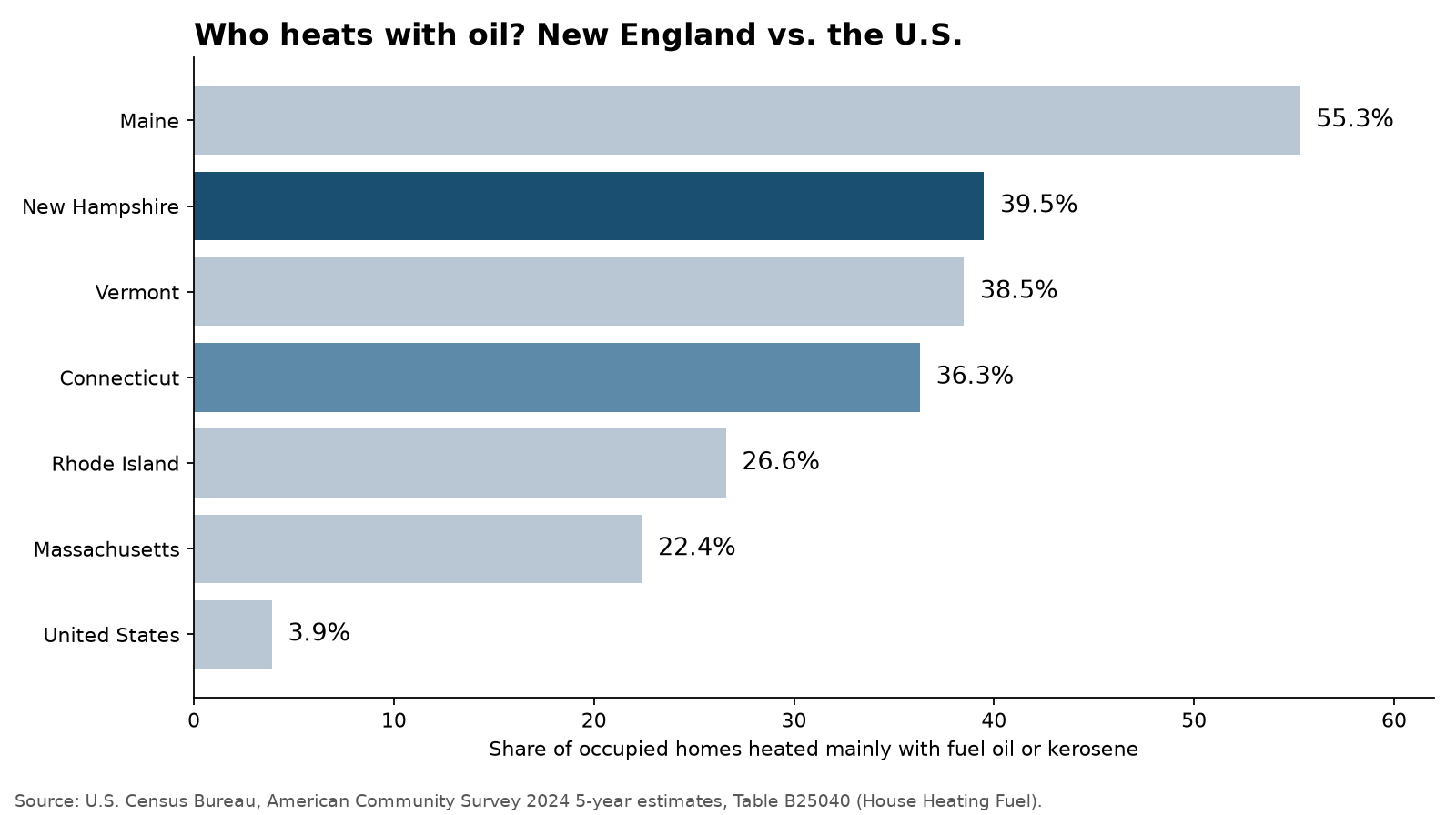
- About 4 in 10 New Hampshire homes heat mainly with fuel oil or kerosene, roughly ten times the national share (Census, ACS 2024).
- Many homeowners policies exclude or limit pollution cleanup, so an oil leak may be only partly covered, or not covered at all.
- The state Petroleum Reimbursement Fund is excess coverage: you file with your insurer first and send NHDES the insurer’s written decision.
- Fund eligibility depends on a tank that meets NFPA 31, the State Fire Code and NHDES best practices, so upkeep matters before anything leaks.
- Income-qualified owners can get help replacing or removing an old tank through NHDES’s Safetank program.
You go down to the basement to check the boiler on the first cold night in October and smell it before you see it: a dark stain under the old 275-gallon tank. Will your homeowners insurance pay to clean that up? Often only part of it, and sometimes none. Many policies exclude or cap pollution, and heating oil counts. That’s why New Hampshire has a backstop, the Petroleum Reimbursement Fund, which steps in after your insurer decides what it will and won’t cover. Here’s how the two fit together, as of October 19, 2026.

How common is oil heat in New Hampshire?
Very. The Census Bureau’s American Community Survey counts 219,764 New Hampshire homes that heat mainly with fuel oil or kerosene, about 39.5% of occupied homes. Connecticut sits at 36.3%. Nationally it’s 3.9%.
Drive through the older neighborhoods of Portsmouth, Dover or Exeter and you’ll pass plenty of fill pipes poking out of foundations. If you own an older house, our guide to historic home insurance in Portsmouth covers the other quirks insurers look at.
Does homeowners insurance cover an oil tank leak?
It depends on the policy and on how the leak happened. Three things usually decide it:
- The pollution wording. Many homeowners policies exclude damage from pollutants or cap cleanup at a low sublimit. Some carriers offer an endorsement that adds limited fuel oil coverage. Others don’t.
- Sudden versus gradual. A line knocked loose is a different claim from a tank that rusted through over years. Wear, tear and corrosion are common exclusions.
- Where the oil went. Oil on the basement floor is one problem. Oil in the soil, the groundwater or a neighbor’s well is a bigger one, and it raises liability questions.
That last point matters in New Hampshire. Under RSA 146-A:3-a, NHDES explains, anyone who causes or suffers a discharge of oil that reaches surface water or groundwater is strictly liable for the resulting costs, regardless of fault. If groundwater is affected, NHDES issues a Notice of Strict Liability that spells out what it expects from your insurance. Liability coverage on your homeowners policy may come into play for damage to neighbors’ property, which is one reason our New Hampshire homeowners insurance reviews look at liability limits along with the dwelling.
One more distinction: equipment breakdown coverage is about sudden mechanical failure of a boiler or furnace. It isn’t pollution coverage.
| Situation | Homeowners policy | State Petroleum Fund |
|---|---|---|
| Oil cleanup on your own land (soil) | Ask about pollution exclusions, sublimits and any fuel oil endorsement | Possible excess coverage after your insurer’s first-party decision |
| Oil reaches groundwater, a well or a neighbor’s property | Ask whether liability coverage responds | Possible excess coverage after your insurer’s third-party decision |
| Corroded or substandard tank | Wear, tear and corrosion are common exclusions | Eligibility can be delayed or denied if the tank isn’t in compliance |
| Replacing an old tank before it leaks | Maintenance isn’t an insurance claim | Not the fund; see NHDES Safetank for income-qualified owners |
How does the NH Petroleum Reimbursement Fund work?
For home heating oil tanks, which NHDES calls on-premise-use facilities, the fund acts as excess insurance. NHDES says it’s available when there’s no private insurance, no coverage, or only limited coverage. Costs your insurer pays aren’t reimbursable.
Your insurer goes first
Before you ask the fund for anything, you file a claim with your insurance company. NHDES wants the claim to ask specifically about two kinds of coverage: damage to your own land (first-party) and damage to the waters of the state or neighboring properties (third-party). A first-party determination is required once soil contamination turns up. A third-party determination is added when groundwater or surface water is affected.
Here’s the part people miss. NHDES won’t accept your own reading of the policy, or your agent’s. Only a coverage determination from the insurance company or an authorized adjuster counts. If you have no policy in force, you send a notarized letter saying so.
What the fund pays, as of October 19, 2026
- NHDES-required cleanup, including emergency response, site investigation, remediation and groundwater monitoring
- Third-party damage claims, including costs from a third-party lawsuit, for eligible tank owners
- An aggregate limit of $500,000 per occurrence for on-premise-use heating oil tanks, after a deductible set by RSA 146-D:6, IV
- Only work NHDES pre-approves for scope and budget

“If you heat with oil, look up what your homeowners policy says about fuel oil leaks before you ever need it. Many policies limit pollution cleanup, and that limit can be a lot lower than a basement cleanup costs. If a leak does happen, call your insurer first and get their decision in writing, because the state fund needs that letter. And if your tank is getting old, replacing it early is usually far easier than cleaning up after it.”
What should I do first if my oil tank leaks?
- Safety first. If there’s a strong odor, fire risk or anyone feels sick, call 911 or your local fire department.
- Report it to NHDES Spill Response: (603) 271-3899, Monday to Friday, 8 a.m. to 4 p.m. Evenings and weekends, call State Police Dispatch at (603) 223-4381.
- Stop the source if you safely can. Call your oil dealer or service company and stop deliveries.
- Document everything. Photos of the tank, lines, stain and surroundings; the tank’s age and last service date; delivery records.
- Open a claim with your insurer. Ask in writing about both first-party (your land) and third-party (groundwater and neighbors) coverage.
- Keep the written decision. You’ll need the insurer’s or adjuster’s letter for any fund application.
Phone numbers from the NHDES Spill Reporting page, checked October 19, 2026.
How do I keep my tank eligible for state help?
This is the cheap insurance. To qualify for the fund, NHDES says a home tank system has to comply with federal, state and local rules, including NFPA 31 and NHDES’s best management practices for on-premises-use heating oil tanks. The guidance notes that most of these are the familiar 275-gallon tanks in private homes. A few basics from it:
- Tanks should be installed indoors whenever possible.
- Outdoor tanks need protection from freezing and thawing soil, which shifts tanks and stresses lines through a New Hampshire winter.
- It covers the whole system, from the fill pipe to the burner connection.
- Have the tank and lines checked at your burner tune-up, and keep the paperwork.
If an older tank needs to go, look at NHDES’s Safetank program. As of October 19, 2026, it helps income-qualified homeowners with up to $4,000 to upgrade or replace an aboveground heating oil tank and up to $4,500 to remove an underground one, usually paying the pre-approved contractor directly. NHDES says Safetank is still available after a release.
What should I ask my agent before heating season?
- Does my policy exclude pollution, or is there a sublimit for fuel oil cleanup?
- Is a fuel oil or oil tank endorsement available from my carrier, and what does it actually cover?
- Would my liability coverage respond if oil reached a neighbor’s well or yard?
- If I’m buying a house with a buried tank, what will carriers want to see?
We’re independent, so we can put those questions to more than one carrier before the first delivery of the season, not after.
Frequently asked questions
Does homeowners insurance cover an oil tank leak in New Hampshire?
Sometimes, and often only partly. Many homeowners policies exclude or cap pollution cleanup, and heating oil counts as a pollutant. Damage caused by a covered event may be treated differently from a slow leak from a corroded tank. Your insurer’s written coverage decision is the only answer that counts.
What is the New Hampshire Petroleum Reimbursement Fund?
It’s a state fund run with NHDES that reimburses NHDES-required cleanup and third-party damage costs from petroleum releases. For home heating oil tanks it works as excess insurance: it pays when there’s no private insurance, no coverage, or only limited coverage.
Do I have to file with my insurance company before applying to the fund?
Yes. NHDES says owners must file a claim with their private insurer first and include the insurer’s or adjuster’s written coverage determination with the fund application. If you have no policy in force, you provide a notarized letter saying so.
How much will the fund pay for a home heating oil leak?
As of October 19, 2026, NHDES lists an aggregate limit of $500,000 per occurrence for on-premise-use heating oil tanks, after a deductible set by RSA 146-D:6, IV. NHDES has to pre-approve the cleanup work and budget.
What could make my tank ineligible for the fund?
The most common problem is a tank system that isn’t in compliance with NFPA 31, the State Fire Code and NHDES’s best management practices for home heating oil tanks. Paperwork gaps, like a missing insurance determination, can also delay eligibility.
Will one oil leak claim get my homeowners policy non-renewed?
Under RSA 417-B:3-a, as described by the New Hampshire Insurance Department, an insurer can’t non-renew a homeowners policy based solely on one valid claim in the current or previous policy term.
Sources
- NH Department of Environmental Services, “Petroleum Reimbursement Fund FAQs”
- NH Department of Environmental Services, “Heating Oil” (Safetank program)
- NH Department of Environmental Services, “Spill Reporting”
- NHDES, “Best Management Practices for the Installation and Upgrading of On-Premises-Use Heating Oil Tanks”
- New Hampshire Insurance Department, “Homeowners and Renters Insurance”
- U.S. Census Bureau, American Community Survey 2024 5-year estimates, Table B25040 “House Heating Fuel”
Reviewed by Jon Merwin, Founder and CEO, Licensed Insurance Advisor.
Portsmouth Atlantic Insurance is the most-reviewed independent insurance agency in New Hampshire, with 1,000+ Google reviews and over 2,000 testimonials.
Related guides: Historic Home Insurance in Portsmouth, NH · What Is Equipment Breakdown Coverage? · How Long Does a Home Insurance Claim Take?
Next step: see our New Hampshire homeowners insurance options.