Auto · CT
Reviewed by Jon Merwin, Founder and CEO
Published: October 22, 2026 · Updated: October 23, 2026
- In Connecticut, hitting a deer is covered by the comprehensive part of your auto policy, not collision. If you carry liability only, or liability plus collision, the damage to your car isn’t covered.
- Swerving and hitting a guardrail, tree or another car is usually a collision claim instead, with its own deductible.
- You still pay your comprehensive deductible on a deer claim.
- CT DEEP asks drivers to report every deer or moose crash to police or DEEP (24-hour line: 860-424-3333).
- Deer season peaks in November. Dawn and dusk are the riskiest hours on Connecticut roads.
It’s 5:30 on a November evening on Route 110 in Shelton, the light’s going, and a deer steps out of the trees. If you hit it, does your car insurance pay? In Connecticut, the answer depends on one line of your policy. The Connecticut Insurance Department says damage from an animal strike falls under comprehensive coverage, which is optional. If you only carry liability, or liability and collision, the repair bill is yours. So if you just hit a deer, or you’re worried you might, the first thing to check is whether comprehensive is on every car you own.
We hear from Connecticut drivers about this every fall, usually the morning after. Here’s how the coverage works, what to do at the scene, and what to ask before the rut hits its stride.
Does my car insurance cover hitting a deer in Connecticut?
Yes, as long as you carry comprehensive. The Insurance Department’s “Steer Clear of Deer” guidance is direct about it: damage to a vehicle from an animal strike is covered under an auto policy’s optional comprehensive portion. It also spells out the gap people miss. With liability-only coverage, or liability with collision, your carrier will not pay for damage to your vehicle from an animal strike.
That surprises people. Collision sounds like the coverage for, well, a collision. But insurers treat an animal strike like other things you can’t control, the same bucket as theft, fire, vandalism, hail, flood and falling objects. That’s comprehensive.
Connecticut law requires liability coverage, and our guide to Connecticut car insurance requirements walks through the state minimums. Comprehensive isn’t required by the state, though a lender or leasing company usually requires it while you’re still paying off the car. Once the loan is paid, some drivers drop it to trim their bill. On an older car that can make sense. On a car you couldn’t easily replace, it’s worth a second look before deer season.
Comprehensive vs. collision: which one pays?
| What happened | Coverage that usually responds | Why |
|---|---|---|
| You hit a deer head-on | Comprehensive | The Insurance Department classifies animal strikes as comprehensive. |
| A deer runs into the side of your parked or moving car | Comprehensive | Still an animal strike. |
| You swerve to miss a deer and hit a guardrail, tree or mailbox | Usually collision | Your car struck an object. Collision has its own deductible. |
| You swerve and hit another car | Usually collision, plus liability for the other car | The other driver’s damage and injuries fall under your liability coverage. |
| You carry liability only | Nothing for your own car | Liability pays others, not you. |
| Glass or windshield damage from the strike | Comprehensive | Ask whether your policy has separate glass terms. |
One more point the Insurance Department makes: a comprehensive claim still means paying your deductible. After that, the insurer covers the claim up to your policy limits. If your comprehensive deductible is high, a minor dent may not be worth a claim. A crumpled hood and broken headlight usually is.
Why shouldn’t I swerve to avoid a deer?
Because the deer is often the smaller problem. The Insurance Department’s advice is to hold the wheel firmly, brake and come to a stop, and to try not to swerve, since swerving can send you into a tree or oncoming traffic. AAA Northeast said the same thing more bluntly in a release covered by CT Insider (“Deer mating season means extra caution needed on Connecticut’s roadways, AAA says,” Oct. 16, 2025): going right can put you into a pole or tree, and going left risks a head-on crash.
There’s an insurance angle too, though safety comes first. Hitting the deer is a comprehensive claim. Hitting the tree you swerved into is usually a collision claim. Same scary moment, different coverage, different deductible.

[QUOTE NEEDED FROM Jon Merwin]
What should I do right after hitting a deer?
Most of this comes straight from the Insurance Department and CT DEEP. Keep it on your phone.
- Get safe. If you can, move the car to the shoulder and turn on your hazard lights.
- Stay away from the animal. A hurt or frightened deer can lash out.
- Call for help if needed. If the car can’t move or the animal is blocking traffic, call the police so they can clear the road.
- Report it. CT DEEP asks that every deer or moose collision be reported to local or state police or DEEP Environmental Conservation Police. DEEP’s 24-hour dispatch: 860-424-3333.
- Take photos. Your car’s damage, the road and any injuries.
- Check the car before driving. Look for leaking fluid, broken lights and loose parts. When in doubt, call a tow truck.
- Call your agent or carrier. Report the damage and ask whether it falls under comprehensive or collision.
When and where are Connecticut deer crashes most common?
According to CT DEEP’s September 2025 advisory, the white-tailed deer breeding season, the rut, runs from late October through late December, and deer are more likely to cross roads then, especially in the early morning and evening. Moose are a smaller risk here, but DEEP notes they’re harder to spot at night and often hit the windshield.
The crash data backs that up. A CT Insider analysis of the Connecticut Crash Data Repository, published in the Connecticut Post (“Connecticut drivers are entering peak deer crash season,” Oct. 8, 2026), found November has consistently had the most deer crashes since 2015. About 35% of deer-related crashes happened between 5 and 9 p.m., compared with 22% of all crashes. That’s the evening Metro-North commute window for a lot of Fairfield County drivers heading home from the Stratford or Bridgeport stations.
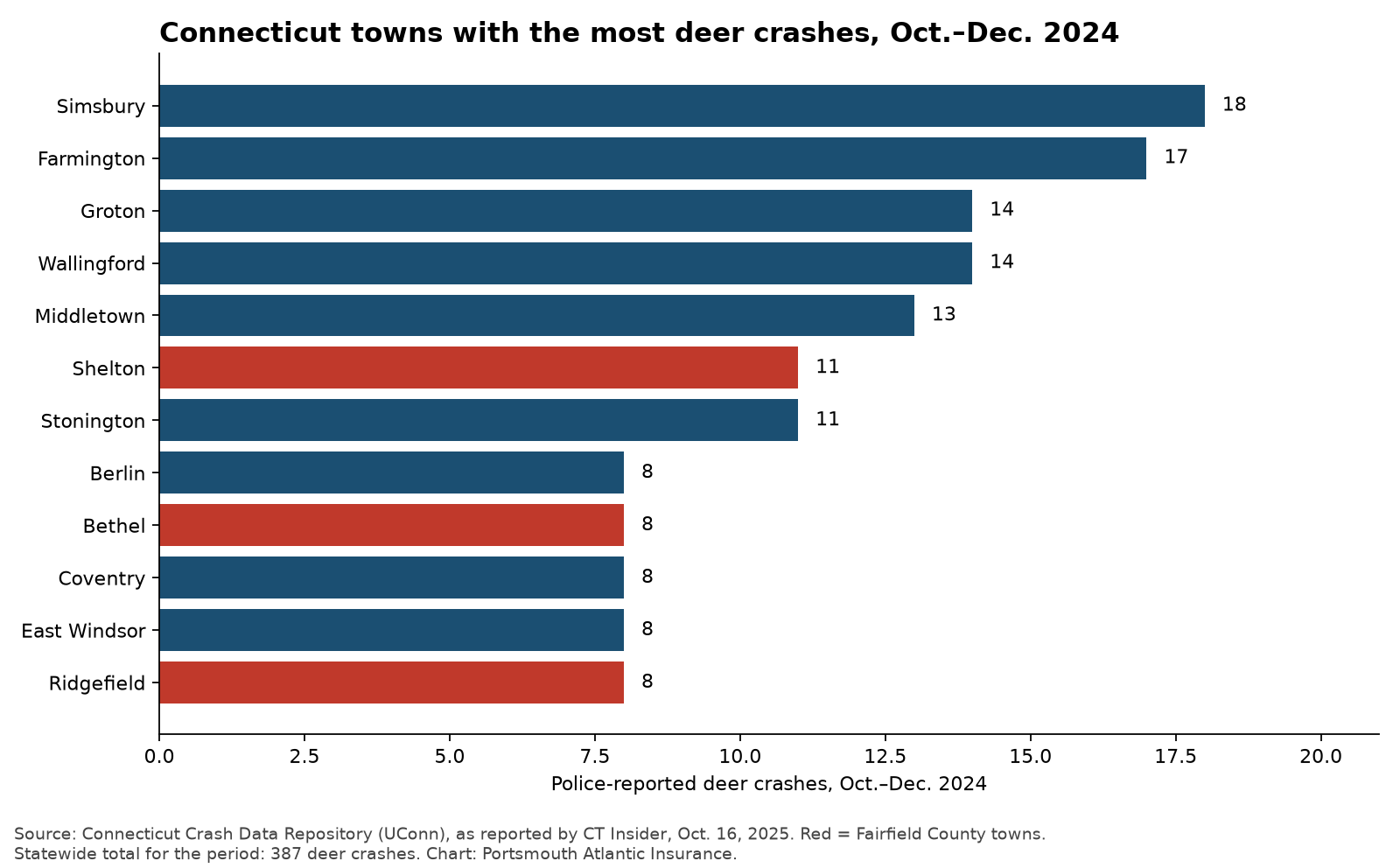
Three Fairfield County towns made that list: Shelton, Bethel and Ridgefield. And these are only police-reported crashes. Plenty of deer strikes never get a police report, so the real numbers are higher.
Will a deer claim raise my rate?
We can’t promise how any single carrier will handle it. Comprehensive claims are generally viewed differently from accidents where you hit something, but carriers set their own rating rules. If cost is on your mind, our post on what drives car insurance costs in Connecticut covers the factors that matter. The better move is to ask before you file. We can walk through your deductible, the damage and how your carrier tends to treat comprehensive claims.
Questions to ask your agent before November
- Do all my cars carry comprehensive, and what is each deductible?
- Do I have collision too, in case I swerve and hit something?
- Does my policy include rental reimbursement or towing if the car isn’t drivable?
- Are my liability limits high enough if a deer crash pushes me into another car?
Frequently asked questions
Does car insurance cover hitting a deer in Connecticut?
Yes, if you carry comprehensive coverage. The Connecticut Insurance Department says damage to a vehicle from an animal strike is covered under the optional comprehensive portion of an auto policy. Liability-only coverage, or liability with collision, will not pay to fix your car after an animal strike.
What if I swerved to miss the deer and hit a guardrail or tree instead?
That is usually handled as a collision claim rather than a comprehensive claim, because your car struck an object. Collision coverage has its own deductible, and it is optional, so check that you carry it. The Insurance Department and AAA both advise against swerving for safety reasons.
Do I pay a deductible on a deer claim?
Yes. The Connecticut Insurance Department notes that a comprehensive claim still requires you to pay your deductible, and the insurer covers the rest of the covered damage up to your policy limits.
Do I have to report a deer crash in Connecticut?
CT DEEP says all deer and moose vehicle collisions should be reported to local or state police or to DEEP Environmental Conservation Police. DEEP’s 24-hour dispatch number is 860-424-3333. Call your insurance company or agent to report the damage too.
When are deer crashes most common in Connecticut?
Fall. CT DEEP says the white-tailed deer breeding season runs from late October through late December, and CT Insider’s review of state crash data found November has consistently had the most deer crashes, with dawn and dusk the riskiest times of day.
Sources
- Connecticut Insurance Department, “FAQs: Steer Clear of Deer” (checked Oct. 12, 2026)
- CT Department of Energy and Environmental Protection, “DEEP Advises Motorists to Watch for Deer and Moose Along Roadways,” Sept. 5, 2025
- Connecticut Crash Data Repository, University of Connecticut
- CT Insider, “Deer mating season means extra caution needed on Connecticut’s roadways, AAA says,” Oct. 16, 2025
- Connecticut Post, “Connecticut drivers are entering peak deer crash season,” Oct. 8, 2026
- Hartford Courant, “Dangerous time for CT motorists: Peak season for deer crashes,” Oct. 28, 2024
Reviewed by Jon Merwin, Founder and CEO.
Portsmouth Atlantic Insurance is New Hampshire’s highest-rated agency on Google, with 1,000+ Google reviews and over 2,000 testimonials.
Related guides: Connecticut Car Insurance Requirements · How Much Is Car Insurance in Connecticut? · Auto Liability Insurance: What Does It Cover?
Next step: see our auto insurance options for Connecticut drivers.